

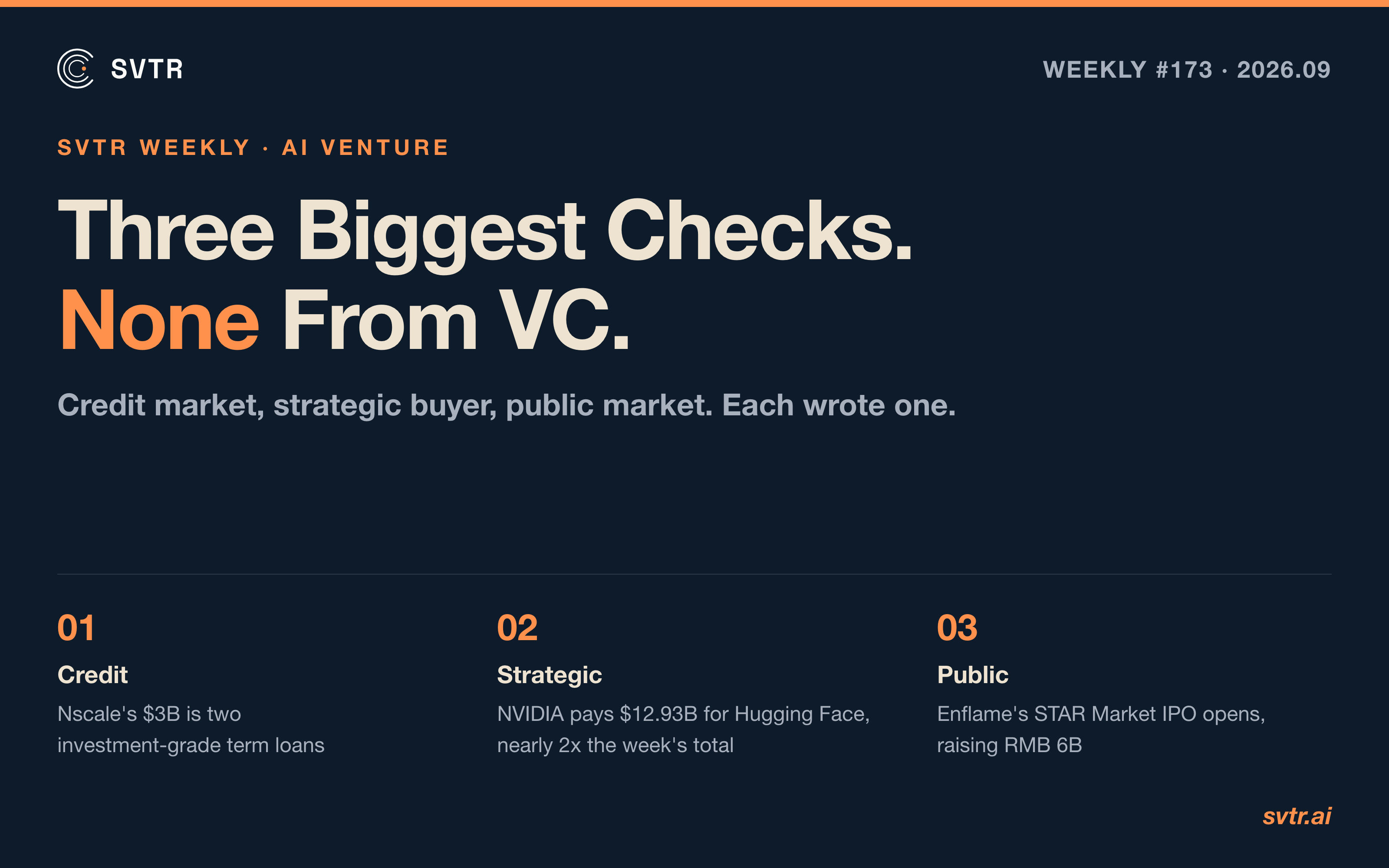
The three biggest checks in AI this week did not come from venture capital.
The ledger looks ordinary: 83 confirmed rounds and roughly $7B disclosed, in line with recent weeks. What is not ordinary is the legal form the money took. The largest item on the list is a bank loan. The second largest transaction of the week was an outright acquisition, and it was nearly twice the size of every round combined. The third was a public offering in Shanghai. The largest venture equity round anyone wrote all week was $300M.
The week in one card
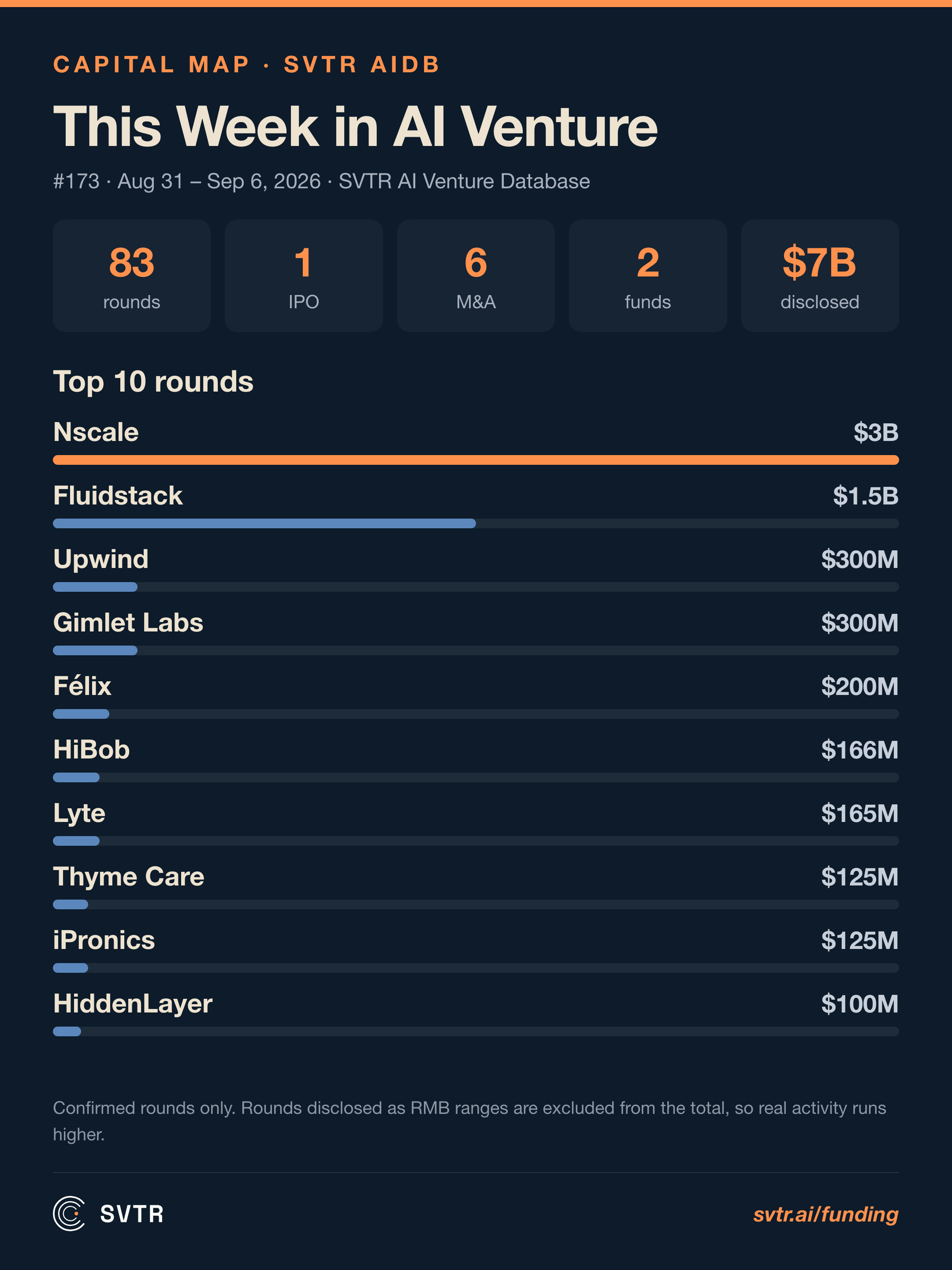
Three ratios worth quoting. The top 10 rounds took $5.981B, more than 80% of everything disclosed, and the top two alone took close to two thirds. Within that top 10, four companies sell compute or data center capacity, and they took $4.925B, about 70% of the week’s disclosed total. And more than ten Chinese rounds this week disclosed only a range in RMB, which we exclude from the total, so real activity runs higher than the chart shows. Deal-by-deal sources are in the full ledger.
The top of the list is a loan, not a round
*Nscale*’s $3B is not a financing round. It is two senior secured delayed-draw term loans against specific data center campuses. The Ward County, Texas facility can draw up to $1.85B to deploy NVIDIA GB300 and VR200 systems supporting roughly 275 MW of IT load. The Madison County, North Carolina facility can draw up to $1.2B, covering the retrofit of a 96-acre site plus GPUs and networking gear. J.P. Morgan and Goldman Sachs are the lead arrangers on the two campuses respectively, and both loans carry investment-grade ratings with a stable outlook.
In the same week Nscale signed a strategic agreement with *Figure*: Nscale took an equity stake in Figure, and Figure committed to an initial $3.5B of compute purchases with intent above $6B, up to 100,000 NVIDIA GPUs, with deployment starting in Barstow, Texas in the second half of 2027. A long-term purchase contract on one side, an investment-grade loan on the other, at the same company in the same week. Once the offtake exists, the lender is underwriting a contract rather than a company.
*Fluidstack* raised $1.5B led by Jane Street Capital at an $18B valuation. Two months ago that number was $7.5B.
The second tier is more familiar territory. *Gimlet Labs took a $300M Series B led by Andreessen Horowitz, with Arm and Microsoft’s M12 participating, for an inference cloud that runs across multiple chip vendors; the company says contracted revenue added since March runs into the billions and its data center pipeline is measured in gigawatts. iPronics raised $125M to push programmable optical networking into AI data centers, with NVIDIA and Robert Bosch Venture Capital participating. Upwind* took $300M at a $3.8B valuation for cloud security, co-led by Bessemer Venture Partners and TCV, and that is the largest pure venture equity round of the week.
What NVIDIA actually bought
NVIDIA announced on September 3 that it will acquire *Hugging Face* for $12.93B, of which roughly $11.9B goes to shareholders and up to $1B is an employee retention equity plan, with closing expected in the first half of 2027. Hugging Face had raised $335M across its life. The platform hosts 3M models and 500K datasets, with 18M developers and 200K companies using it.
Jensen Huang’s stated commitment is that it stays open, that users are not required to use NVIDIA products, and that support for AMD and Intel hardware continues.
The number is the story. $12.93B is close to twice the disclosed total of all 83 rounds this week. NVIDIA did not buy compute, which it already sells. It bought the first stop a developer makes when choosing a model.
The Shanghai side of the same pattern
*Enflame Technology* opened its STAR Market subscription on September 2 at RMB 142.18 per share, raising up to RMB 6B. Its prospectus contains one set of numbers worth reading twice: Tencent holds 20.26% as the largest shareholder and is also the largest customer, and Tencent’s share of Enflame’s revenue rose from 33.34% in 2023 to 83.79% in 2025. A domestic AI chip company reaching an offering with eight tenths of its revenue coming from its own largest shareholder is both the reason it got here and the first question it has to answer as a public company.
A second sample from the same week: *PlusAI* signed a merger agreement with Texas Ventures Acquisition III at an $800M valuation, its third attempt at going public. In June 2025 it was negotiating with Churchill Capital IX at $1.2B, a deal terminated this April. Same company, same autonomous trucking business, and the price the public market is willing to pay fell by a third in fourteen months.
Our read
AI’s private market is sorting itself by asset type, and venture capital has been pushed into the middle layer.
Compute at the bottom has predictable cash flow and collateral you can foreclose on, so it goes to banks and gets priced on credit rather than growth. That is why the biggest number of the week carries a credit rating instead of a valuation. The ecosystem entry point at the top has strategic value to an incumbent, so it gets bought for cash and gets priced on control. The middle layer, software and model companies that have not yet built contracted revenue, remains venture’s ground, but the ceiling on a single check sits around $300M.
Which layer a company occupies is now better predicted by how it raises money than by the sector label attached to it. The mechanics of the compute layer specifically, where the financeable asset has shifted from the company to the contract, are covered in this week’s Signal.
Full issue, with every round and its source: SVTR Weekly #173.