

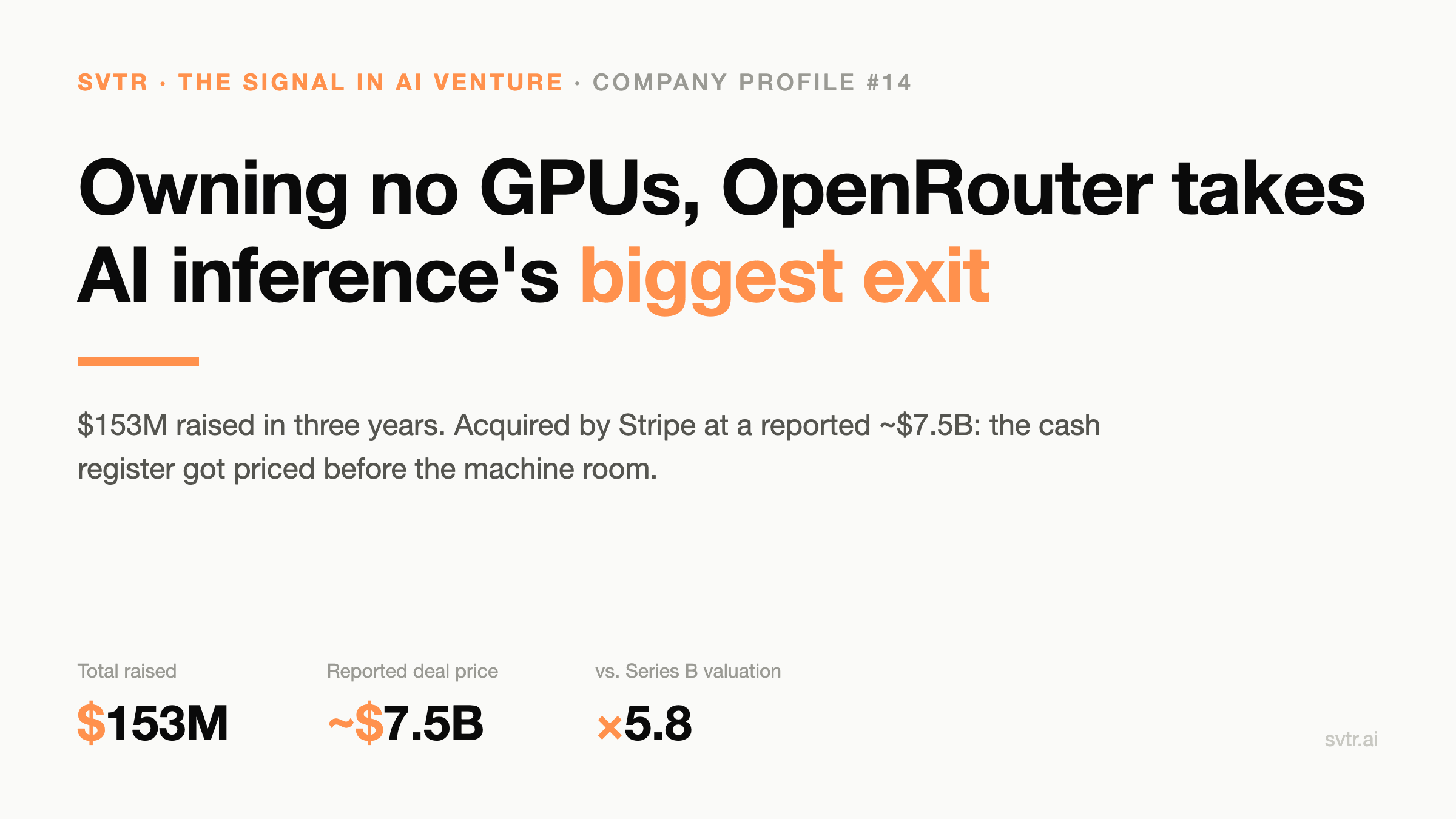
On August 19, 2026, Stripe announced its acquisition of OpenRouter. The company trains no models and owns not a single GPU; it raised just $153M over three years. According to Bloomberg’s August 16 report, the deal is worth roughly $7.5B, nearly five times its Series B valuation three months earlier, with about $1.5B going to the two founders. Meanwhile, the capital-heavy inference clouds in the same sector, which raised more than ten times as much to buy GPUs and build clusters, have yet to see a single exit. The first big exit in AI inference went to the metering layer that sits on the path every bill must travel: once tokens became an expense enterprises need to settle, the cash register got priced before the machine room.
You can browse OpenRouter’s live company record in the SVTR AI Venture Database, with every round and participant tracked.
The OpenSea playbook, applied to models
Alex Atallah’s previous company was OpenSea. He co-founded the NFT marketplace with Devin Finzer in 2017, and the thesis was the same one: when assets are highly fragmented and buyers can’t find sellers, whoever builds the aggregation and matching layer captures the transaction flow. He left OpenSea in August 2022 as the crypto market receded. After ChatGPT launched, he first built Window.ai, a browser extension letting users bring their own model to any webpage, and quickly found the real pain point elsewhere: models were multiplying, but their interfaces remained scattered.
In May 2023 he founded OpenRouter with Louis Vichy, author of the browser extension framework Plasmo. According to Contrary Research, Atallah’s bet at the time: Stanford’s Alpaca had been fine-tuned into a usable model for about $600, so the world would eventually hold hundreds of thousands of models, and inference could become software’s largest spending category. That was his own vision statement, but three years later Stripe endorsed the direction with real money.
Selling routing, accumulating market-wide price data
OpenRouter’s product is a unified API layer: 400+ models from 80+ providers (per Stripe’s acquisition announcement, August 2026). Developers write code once and switch between OpenAI, Anthropic, Google, and DeepSeek based on cost, latency, and reliability, with automatic failover when a provider goes down. NVIDIA, Zoom, and Lovable are on the customer list.
The moat is the public leaderboard: which model is being used by whom, for coding or marketing, and how usage shifts week over week. The industry treats it as the default reference for real model market share. The actual usage distribution of 8 million users (May 2026, per TechCrunch) feeds back into its routing algorithms. Developers who need to choose models and model labs that need to reach developers both depend on this pricing board.
15x in 14 months, and the cap table that called it
Per the SVTR AI Venture Database, OpenRouter’s funding history is a curve of accelerating validation:
• June 2025: combined Seed and Series A of $40M, led by a16z and Menlo Ventures with Sequoia participating, at a valuation of roughly $500M;
• May 2026: $113M Series B led by Alphabet’s CapitalG at $1.3B post-money, more than doubling its valuation within a year;
• August 2026: Stripe acquisition at a reported ~$7.5B, nearly five times the Series B mark.
The business numbers chased the valuation: ARR grew from $10M in October 2025 to $50M in April 2026, five times in five months; monthly token throughput hit 100 trillion (May 2026). Stripe’s letter to investors gave an even sharper measure: OpenRouter’s token consumption has compounded at 9% per week so far in 2026, growth “frenetic even by AI standards.”
The Series B cap table had already foreshadowed this acquisition. Beyond CapitalG the round included five corporate strategic investors: NVIDIA’s NVentures, ServiceNow, MongoDB, Snowflake, and Databricks. When chip, data, and enterprise software giants converge on the same middleware layer, the company was already being treated as a strategic asset rather than a financial position, back in May 2026. From $500M when SVTR began tracking it in June 2025 to a reported $7.5B fourteen months later, the buyers crowding in were industrial capital throughout.
A 5.5% toll, betting volume outruns falling prices
OpenRouter takes roughly 5.5% of inference spending routed through it. The free tier limits available models; the enterprise tier sells compliance features like SSO and SLA. Working backward from $50M ARR, annualized inference spend settled through the platform is roughly $900M (SVTR estimate).
The model’s key assumption: unit inference prices keep falling, but total spending grows faster. Per Contrary Research’s estimate, inference costs dropped roughly 1,000x from 2022 to 2024, and industry forecasts see another 90% decline from 2025 to 2030. Take-rate revenue equals rate times volume, and volume must keep outrunning price.
Stripe’s plan is to catch exactly this flow. This is Stripe’s largest-ever acquisition, landing after the consecutive purchases of Bridge, Privy, and Metronome. Its letter to investors spells out the logic: capital and intelligence are becoming the two digital flows undergirding every business; every developer has needed a reliable revenue pipeline, which is what gave rise to Stripe, and going forward every developer will also need a reliable intelligence pipeline. Metronome handles metered billing (used by Anthropic and NVIDIA), OpenRouter handles token routing, billing and consumption interlock in the same layer, and the deal is expected to close within weeks. SVTR called the nature of this deal in Weekly #171: Stripe pulled the model traffic gateway into its payments network, in a week when AI’s biggest checks skipped funding rounds entirely.
Heavy capital besieged the sector; the lightest layer exited first
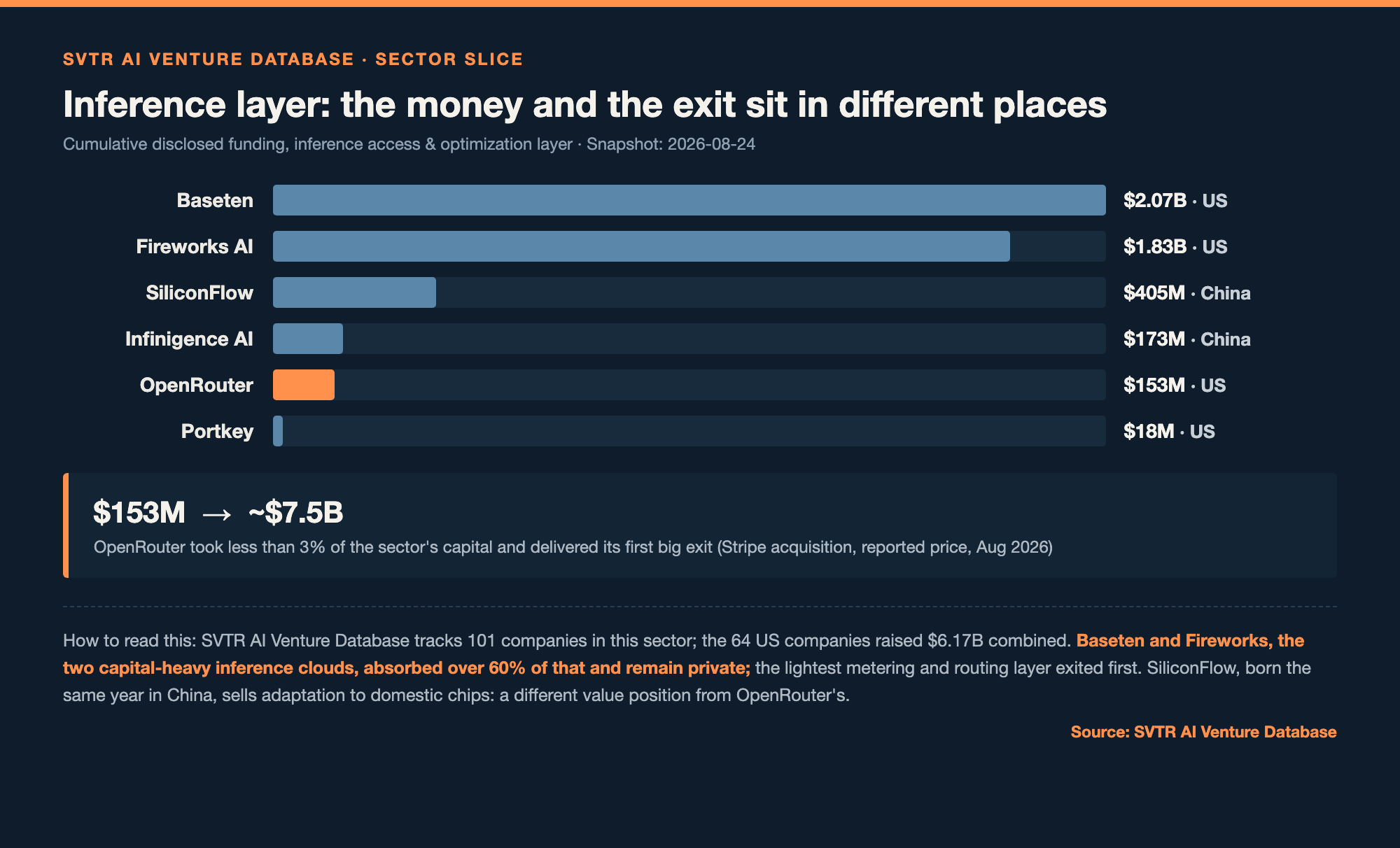
Per the SVTR AI Venture Database, the 64 US companies in this sector raised $6.17B combined, and the two heavy inference clouds Baseten and Fireworks account for over 60% of it. OpenRouter took less than 3% of the sector’s capital yet delivered its first big exit. The heavy layer isn’t losing: Fireworks reached a $17.5B valuation in its July 2026 Series D with over $1B in annualized revenue (per CNBC), and Baseten hit $13B in June. The difference is capital efficiency: one side turned $1.8B of funding into a $17.5B paper valuation; the other turned $153M into a $7.5B realized exit.
China never grew an equivalent, because the fragmentation runs along a different axis. The US is fragmented on the model side: 400+ models need price comparison and switching, so a routing layer has a business. China is fragmented on the chip side: SiliconFlow (also founded in 2023, $405M raised) makes open-source models run on domestic accelerators and charges for compute adaptation. Add China’s inference price war, which has crushed unit prices, and Alibaba’s and ByteDance’s practice of giving away model gateways as cloud on-ramps, and a 5.5% take rate never had room to exist.
Over the past three months we have talked with five teams working at this same infrastructure layer, spanning model gateways, inference scheduling, and cost optimization. Not one of them sells pure routing as a standalone product: it is either embedded in a data distribution network, or folded into model operations, an agent runtime, a cross-border multi-cloud stack, or a deployment optimization service.
The sample is small, but the signal is consistent. *Routing is becoming a capability, not a category*. As differences between base models narrow and switching costs fall, routing gains technical value, but not necessarily independent pricing power alongside it. Outside the US especially, what sustains a fee is rarely “we pick the model for you” on its own; it is the workflow, infrastructure, and customer relationships built around the routing.
A routing layer’s value equals market fragmentation times billing complexity. The US scores high on both, so it could raise an independent OpenRouter. In China the model side has consolidated and gateways are free, leaving no viable position for an independent routing layer; under the same logic, the corresponding value position there is the domestic chip adaptation layer. Founders trying to clone OpenRouter in China have picked the wrong market structure as their reference.
The neutral layer now belongs to an interested party
The first risk is the race between take rate and price decline. Revenue is tied to total inference spending; unit prices fall steeply every year, and if customer volume growth slows, revenue peaks before usage does.
The second is large customers routing around the layer. For a customer spending $10M a year on inference, 5.5% means $550K in annual tolls, and the incentive to integrate directly with model labs is real. OpenRouter’s defense is making its leaderboard, price comparison, and settlement too useful to abandon, but that stickiness has not yet been tested by a major customer’s departure.
The third is the subtlest: neutrality itself. On announcement day Atallah was still emphasizing that “developers need a neutral layer” to orchestrate all models (per Stripe’s announcement). But once the deal closes, OpenRouter belongs to a payments company that also processes checkout for OpenAI, Anthropic, and other model labs. Whether labs keep feeding real price and traffic data to a leaderboard owned by a giant, and whether clouds accelerate replacing it with their own routing (AWS Bedrock already ships intelligent prompt routing), are the two variables most worth watching in the twelve months after the close.
The read
OpenRouter spent three years proving one thing: the first big exit in AI inference went to a company that owns no compute and holds only the metering and settlement position. Once tokens became an expense enterprises must settle, the cash register got priced before the machine room. In our Sarah Guo Profile, SVTR discussed whether independent companies can survive in the inference layer. OpenRouter’s answer is half a yes: independent companies do emerge, but their endgame may not be growing into platforms; more likely they get absorbed into larger infrastructure networks like payments and cloud.
For early-stage investors covering AI infrastructure, the signal is clear: heavy inference clouds consumed 60% of the sector’s capital and are still waiting on exits, while the light metering layer on the bill’s mandatory path cashed out first. The next structurally similar position is the billing and clearing layer for agent transactions, and Stripe’s investor letter already sketches its full stack for that layer: agent registration and discovery, the Tempo blockchain, a machine payments protocol. The buyer has drawn the next map itself.
If this layer is the business you are building, get in touch: we will assess it against the same global standard for your sector and stage, and put you in front of the potential investors and partners inside the SVTR global venture network.