

Capital has started pricing AI’s electricity and heat directly — and the US and China are taking different roads.
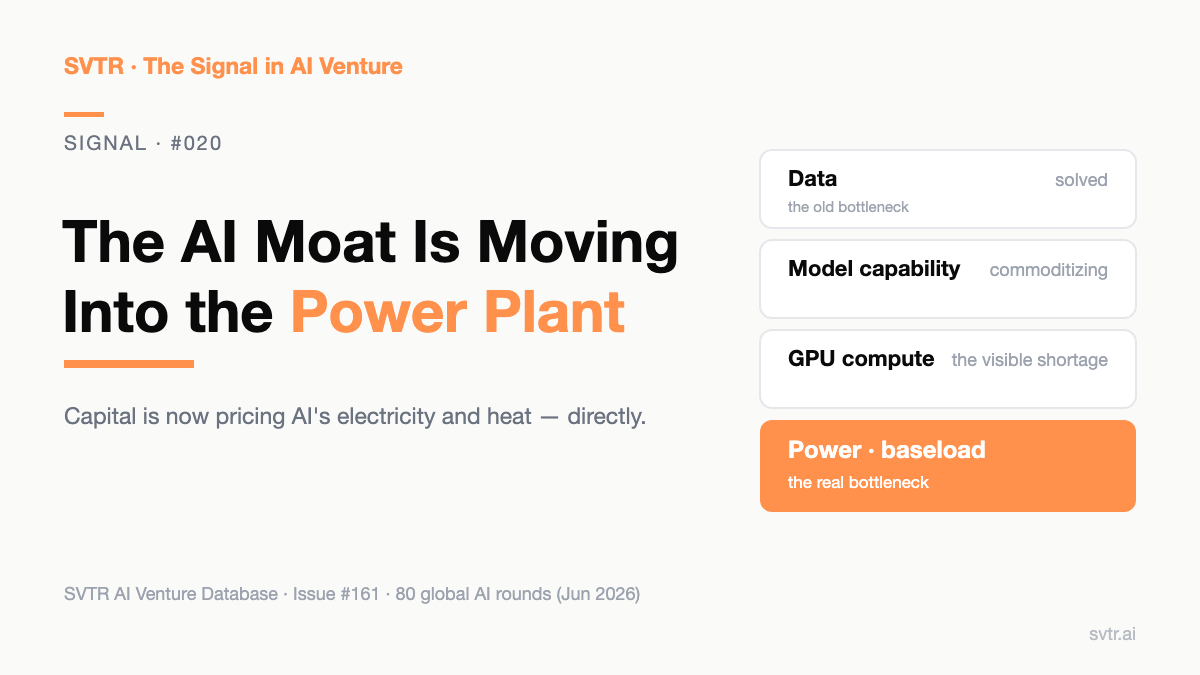
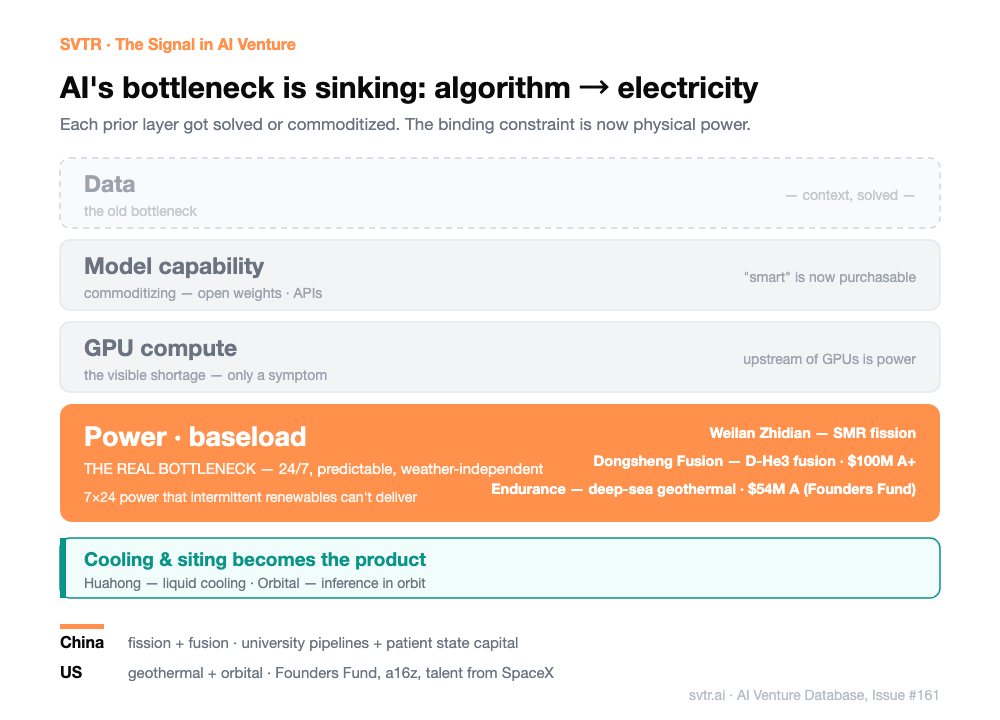
For three years, the assumed bottleneck in AI moved in a clean sequence: data, then model capability, then GPUs. SVTR’s latest weekly issue suggests it has moved one layer deeper — into electricity itself.
In SVTR’s AI Venture Database, Issue #161 (80 global AI rounds, June 2026), some of the largest checks went not to model or chip companies, but to companies answering a physical question: where does the power come from, and where does the heat go?
A caveat we hold ourselves to: SVTR’s weekly issue is a curated sample, not a market-wide census. But ~46% of this issue’s rounds (37 of 80) went to physical-world hardtech, and the direction is consistent enough to flag early. The smallest slice — energy, just three deals — is where the founder profile is changing first. That’s the signal.
1. Capital is funding power generation, not smarter models
Three companies that literally generate power raised large rounds in the same window:
SUNUP Fusion — compact controlled fusion on a deuterium–helium-3 fuel cycle; $100M Series A+.
Endurance Energy — deep-sea geothermal tapping heat near plate boundaries; $54M Series A led by Founders Fund.
Weilan Nuenergy Co., Ltd.,small modular reactors (SMRs, pressurized-water design) purpose-built for AI compute; hundreds of millions of RMB across angel+ and Pre-A.
What unites them isn’t a technology roadmap. It’s what they sell: baseload power. Not peak capacity, not a green label — 24/7, predictable, weather-independent electricity. That is precisely what intermittent renewables can’t deliver and what AI data centers most need. When an industry starts paying a premium for baseload rather than peak compute, its binding constraint has shifted a layer.
2. The founders changed: from model researchers to nuclear engineers
If you only look at the dollars, this reads as “energy is hot again.” The deeper signal is in who is starting these companies.
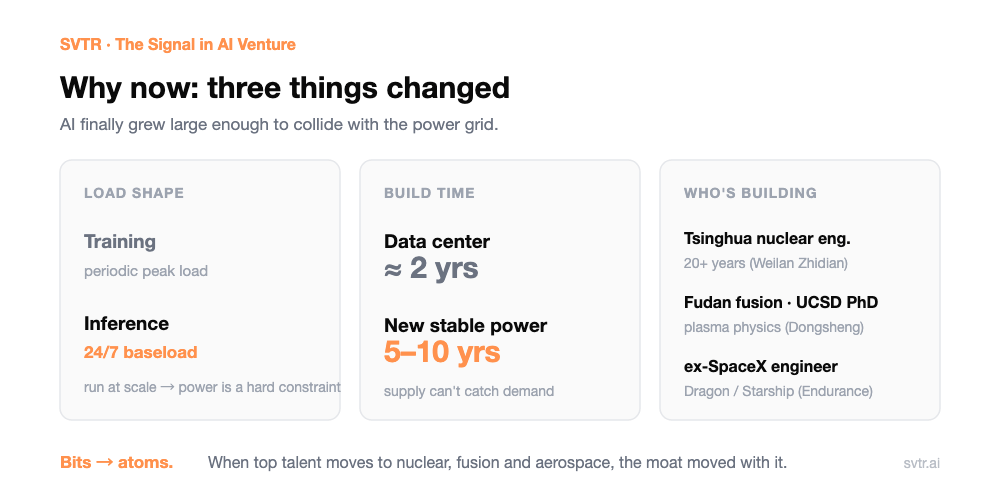
Weilan Nuenergy’s founder spent 20+ years in nuclear engineering, trained at Tsinghua.
SUNUP Fusion’s founder is a Fudan University physics professor with a plasma-physics PhD from UCSD and years running a fusion science institute.
Endurance Energy’s Andrew Redd was a life-support systems engineer at SpaceX, working on Dragon and Starship.
When a field’s top talent migrates from “models and algorithms” toward nuclear engineering, fusion physics and aerospace systems, the genuinely hard, genuinely scarce part of the problem has moved from bits to atoms. Model capability is commoditizing — open weights and APIs turn “smart” into a purchasable input. Getting a reactor onto the grid, or pulling stable geothermal energy from the deep sea, takes a decade of engineering and regulatory relationships. That is the moat software teams can’t replicate on a funding cycle.
3. Power and cooling now define siting — and the US and China diverge
If the scarce input is physical electricity, then where you can get power and where you can dump heat becomes a competitive variable, not a logistics footnote. Two companies in this issue treat siting and cooling as the product itself: Huahong builds fully liquid-cooled edge supercomputing, turning heat dissipation from a data-center constraint into a deployable product; Orbital puts GPUs on satellites, running inference in orbit where power and cooling conditions differ entirely.
The sharper split is in how the two largest markets solve supply. China leans nuclear — fission (Weilan Nuenergy’s SMRs) plus fusion (SUNUP Fusion) — backed by university engineering pipelines and patient state capital. The US is more dispersed — geothermal (Endurance), orbital (Orbital) — backed by dollar funds like Founders Fund and a16z, and talent spilling out of SpaceX and aerospace. For a cross-border investor, “investing in AI’s electricity” is two entirely different underwriting problems.
Why now
The shift is happening now, not earlier, because AI’s load profile changed. Training is a periodic peak load; inference is a continuous baseload. As the industry pivots from training a bigger model to running the model at scale, data-center demand turns from intermittent into a hard 24/7 requirement — and that collides with the grid’s physical limits. A data center takes about two years to build; a new transmission line or a new stable power source takes five to ten. Model gains are slowing and commoditizing while inference demand climbs; the two curves diverging pushed electricity from a background variable to the center of pricing.
Who’s affected
Investors: “powering AI” is becoming its own asset class, but its underwriting looks nothing like SaaS — multi-year timelines, heavy regulation, high capital intensity, exits closer to energy infrastructure than software. Pricing a power plant on software multiples is the easiest mistake for infra funds and software-AI VCs to make. Industrial and deep-tech capital that can read “deliverable, stable megawatts” will capture returns others can’t price.
Founders: at the application layer, inference electricity is becoming a real line in the cost structure, and over time it sets a floor under gross margin. If you’re building infrastructure, the moat is less about technical novelty and more about the ability to secure power — siting, grid connection, long-term power-purchase agreements, regulatory relationships.
Hyperscalers: they’re locking up baseload with long-term PPAs, which both creates demand for independent power and caps it.
Enterprise buyers: remember the long-run conclusion — the floor on inference pricing is set by electricity, not by models.
What we’re tracking (next 90 days)
1. Density and size of energy rounds. Whether new generation deals (nuclear / geothermal / fusion) explicitly tied to AI compute, at $50M+ per round, keep appearing, and whether the median check rises.
2. PPAs and siting. The count of long-term power-purchase or co-location agreements between hyperscale data centers and independent baseload sources (especially nuclear and geothermal).
3. Founder backgrounds. In newly formed “AI infrastructure” companies, the ratio of energy / nuclear / aerospace founders to model-background founders.
SVTR’s AI Venture Database now carries an AI-Energy tag, filter by generation path (fission SMR / fusion / geothermal), cooling and siting (liquid / orbital), and US–China comparison. If you’re evaluating a “power for AI” deal, this taxonomy locates its comparables and where the real risk sits.