

Nine out of ten.
That’s how many of last week’s largest AI funding rounds went to companies building things you can touch — robots, chips, reactors, trucks, energy systems. The top 10 companies tracked by the SVTR AI Venture Database raised nearly $10 billion in combined fresh funding (excluding Project Prometheus’s $10 billion round still in negotiation). The lone exception, VAST Data, counts labs training large physical models among its key clients.
Meanwhile, the hottest pure software Agent startups? They raised between $5 million and $20 million per round. Two orders of magnitude smaller.
This isn’t an AI downturn. It’s a reallocation of capital weight. And if you’re a founder, investor, or enterprise leader in the AI space, the implications are enormous.
What the Money Is Actually Saying
Let’s start with a simple exercise. Add up all the representative software Agent rounds from last week: Orkes ($60M), NeoCognition ($40M), Petual ($20M), Band ($17M), Coral ($12.5M), Brev ($3.3M), Zig.ai ($3M). The total comes to less than $150 million.
That’s roughly equal to the single round raised by Reliable Robotics — a company that flies cargo planes.
Let that sink in.
The capital isn’t just flowing toward physical AI. It’s flooding in across every layer of the stack, forming what looks like a complete industrial architecture for the first time.
The Three-Layer Stack of Physical AI
Think of physical AI as a three-layer system, and last week’s deals lit up all three independently:
The Simulation & Design Layer turns physical processes into computable, optimizable objects. Project Prometheus (in talks for $10B), CuspAI ($200M), and others are building the digital twins and design engines that make physical AI possible. These companies are often misclassified as “software” — but their customers pay based on manufacturing line and lab outcomes, not SaaS subscriptions.
The Compute & Infrastructure Layer provides the chips, data pipelines, and networks optimized specifically for physical AI workloads — not general-purpose GPU training. VAST Data ($1B Series F), EVAS Intelligence (CNY 1.5B), Sunrise (AI inference GPUs), NineTree (neuromorphic chips), and others are building this middle layer.
The Body & Application Layer is the most visible destination for capital. Last week alone, at least five humanoid and industrial robotics companies secured funding: Blue Energy ($380M), DeepWay ($310M Pre-IPO), Reliable Robotics ($160M), Pudu Robotics ($150M at ~$1B valuation), and Booster Robotics (nearly $100M).
Here’s what matters: these three layers now form a closed industrial chain. The simulation layer tells the compute layer “how to build this reactor.” The compute layer tells the body layer “how to drive this truck.” The body layer feeds real-world data back to the simulation layer.
A year ago, this chain was broken. Last week, it connected for the first time in terms of funding rhythm.
Signal 1: Physical AI Deals Are 10x Larger Than Software Agent Rounds
When you split last week’s funding by whether a company delivers physical actions or products, the gap is impossible to ignore:
Physical AI: Median deal size ~$160M per round. Strip out mega-rounds (Prometheus, VAST), and the median still holds at $150M.
Software Agents: Median deal size ~$17M per round. Even the largest round (Orkes, $60M) is smaller than the smallest physical AI round in the top 10.
The gap isn’t 2x or 3x. It’s more than an order of magnitude.
Capital no longer believes the “small check, massive upside” logic holds broadly for Agent startups. The market is repricing in real time.
Signal 2: A Complete Stack, With Independent Funding Across All Layers
If concentrated funding were limited to isolated outliers, it wouldn’t constitute a trend. But last week’s data shows full industrial depth. Capital is flowing independently into simulation, compute, and body layers — each attracting its own dedicated investors and its own deal logic.
That’s what separates a trend from an anomaly. When multiple layers of an industrial chain attract capital simultaneously and independently, you’re looking at a structural shift, not a hot sector.
Signal 3: The “Zero Marginal Cost” Narrative for Software AI Is Hitting a Wall
The core investment thesis behind software AI was elegant in its simplicity: model capabilities would keep breaking through, marginal costs would approach zero, and winners would take all. This narrative supported the sky-high valuations of OpenAI, Anthropic, and Mistral, as well as the “grab the entry point first, build the business later” logic of Agent startups.
That narrative began hitting three boundaries simultaneously in the second half of 2025:
First, the pace of generational leaps in model capability has slowed. Each new model delivers noticeably smaller increments over its predecessor.
Second, Agent startups have become overly homogenized. “GPT-wrapper plus workflow” products went from scarce to template within six months, blurring valuation anchors.
Third, inference costs are not approaching zero. GPU compute has become a hard constraint, making the marginal cost of one API call increasingly close to the marginal cost of delivering one physical service.
Capital won’t wait for the narrative to collapse naturally — it migrates first. And migration destinations must meet two conditions: unit economics must be measurable, and external barriers must not be controlled by large model companies.
The physical world meets both criteria perfectly:
The unit gross margin of a robot, a truck, or a reactor is crystal clear.
The data generated from motion, force feedback, and environmental closed loops is currently inaccessible to OpenAI and Anthropic.
Chinese manufacturing capacity spillover and U.S. reshoring policy tailwinds create a rare window where both cost curves and policy incentives align.
This is the real pricing logic behind Project Prometheus’s $38B post-money valuation. Bezos isn’t investing in the next OpenAI. He’s investing in the AWS of the physical world — a base layer providing simulation and design infrastructure for all downstream vendors building physical AI.
Why Now?
The timing is no accident. Three forces are converging in the same window:
Scaling diminishing returns — Large models have hit marginal diminishing returns simultaneously across algorithms, compute, and data for the first time.
Hardware cost decline — U.S. manufacturing reshoring policies are overlapping with Chinese robotics production capacity spillover, pushing hardware BOM costs into a rapid decline channel.
GPU capex repricing — The market’s patience for “compute-consumption” business models has shortened dramatically.
Who Should Care
If You’re a Founder
Here’s the one question that matters: Does your product have a closed loop from physical action to physical result?
If not — if what you’re building can be summarized as “adding an Agent workflow on top of a large model” — last week’s data suggests your valuation ceiling is likely to keep falling in 2026, not rising.
Conversely, if you can embed AI into a specific physical scenario (a robot joint, a factory production line, a design process step), even a small team is more likely to secure patient capital.
One telling data point: companies that raised more than $100M last week have an average founding year of 2020. The market is willing to pay a premium for teams that have put in five years of hard work.
If You’re an Investor
Time to shift your investment paradigm from SaaS templates back to semiconductor and new energy templates. Physical AI rounds are characterized by large check sizes, long cycles, strong industrial chain ties, and less predictable exit timelines.
Funds that previously specialized in ARR models need to build three new due diligence capabilities:
Hardware supply chains and manufacturing processes
Energy and material structural bottlenecks
Cross-border capacity scheduling
Watch out for a valuation trap: early-stage physical AI valuations are already rising on “strong storytelling,” but it will take 18-24 months to see if unit economics actually work. Don’t apply software AI pacing to these deals.
If You’re Big Tech
Bezos is building a new flagship outside the OpenAI ecosystem via Prometheus.
NVIDIA is locking in the compute consumption side of physical AI through investments in VAST and others.
Microsoft and Google’s relative positions are becoming more nuanced — and potentially more vulnerable.
If You’re an Enterprise Customer
Manufacturing, logistics, energy, and medical devices are the four industries most likely to capture the first wave of “physical AI application dividends” in 2026. If you’re in one of these sectors, the time to start evaluating physical AI vendors is now.
Three Numbers to Watch Over the Next 90 Days
To confirm whether last week’s trend is structural or noise, track these three indicators:
1. The physical-to-software ratio at the $100M+ level. Count how many physical AI companies raise >$100M rounds vs. pure software Agent companies crossing the same threshold. If the gap widens to 5:1 or higher, this is not a one-off anomaly.
2. NVIDIA and TSMC partnership announcements. If 3+ partnerships explicitly target “physical simulation, robotics, industrial AI,” the upstream of the industrial chain has formally tilted.
3. VC thesis language. Track the frequency of “Physical AI,” “Embodied AI,” and “Physical Simulation” in theses or annual letters from top U.S. and Chinese VCs. If it doubles compared to the first half of 2025, LP consensus has formed and capital will concentrate further.
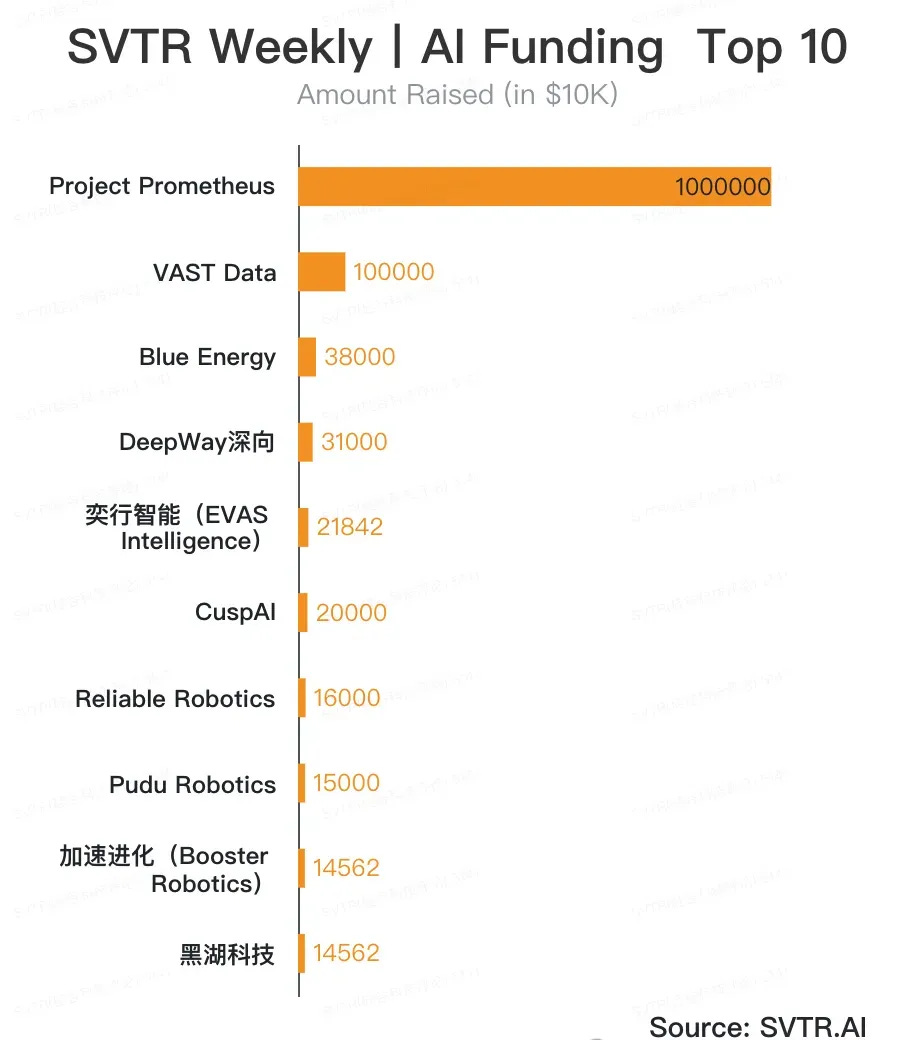
Last Week’s AI Funding Leaderboard
The SVTR AI Venture Database has updated complete data cards for all 6,000+ tracked companies, adding a new “Physical AI” tag. Users can filter more than 30 active targets by the three-layer structure for cross-sector comparison.