

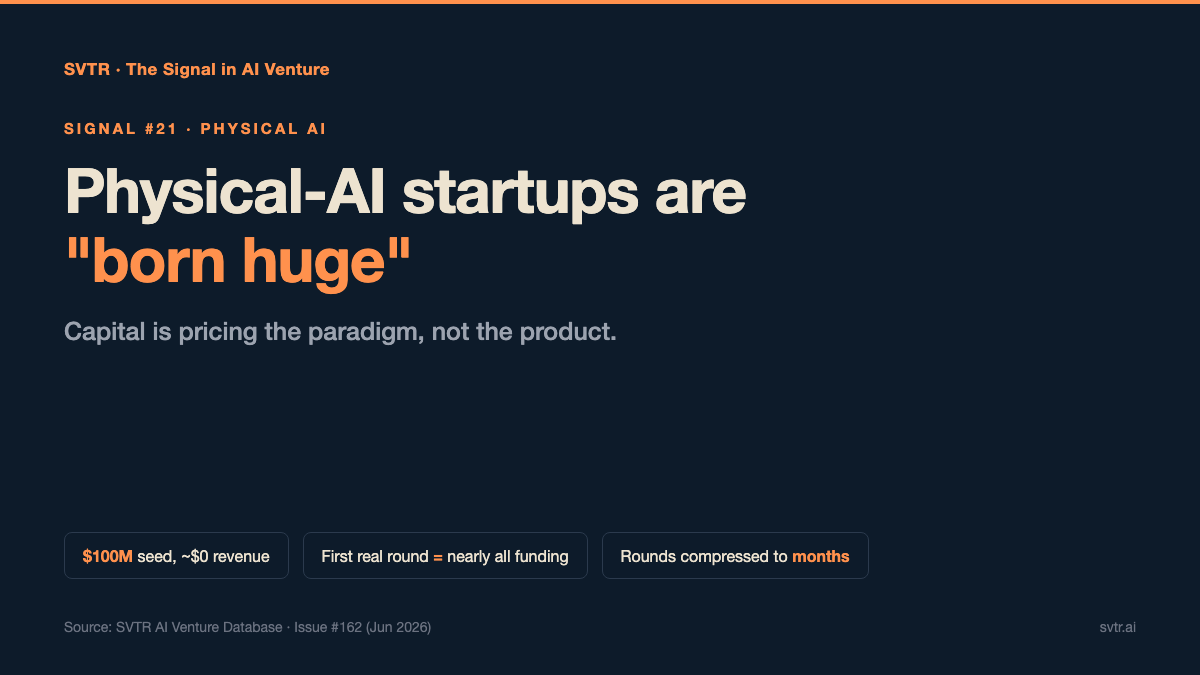
Capital is pricing the paradigm, not the product — and the US and China are buying two different positions with two different kinds of money.
In SVTR’s AI Venture Database this week (Issue #162, ~56 AI rounds), about ten early-stage deals went to the physical world: world models, embodied AI, robotics, AI materials. Most have little to no revenue. Several were priced at $100M–$2B post-money anyway. The size isn’t the story. The timing is.
1. Born huge: the first real round is already enormous
In a healthy early market, a seed round buys “an idea and a team,” and valuation climbs round by round as milestones are hit. Here, that ladder is gone. One company took a ~$100M “seed++” that is essentially its entire funding to date — it has raised once, and once was nine figures. Another raised a $220M Series A at a $2B post with no prior scaled round.
Valuation has decoupled from milestones. The money doesn’t map to a shipped product; it maps to a founder’s position on a technical paradigm. Capital is making a bet: if this paradigm holds, this team is likely still at the table.
2. Round compression: the confirmation window collapses
The second signal is speed. When the anchor shifts from milestones to position, the cadence shifts from “advance on milestones” to “grab the slot before it closes.” Some companies have run the entire Angel-to-Series B sequence in months; round labels lag far behind the cash already in the door.
The counterintuitive part isn’t “they raised a lot”, it’s the collapse of the confirmation window. The interval between rounds is itself information: time for the company to hit milestones, and a window for the next investor to watch. Run that sequence in months and you’ve given the window up. Investors aren’t adding on more evidence; they’re deciding “wait any longer and I lose the slot.” Round compression is capital hedging missing information with speed.
3. Same paradigm bet, two playbooks
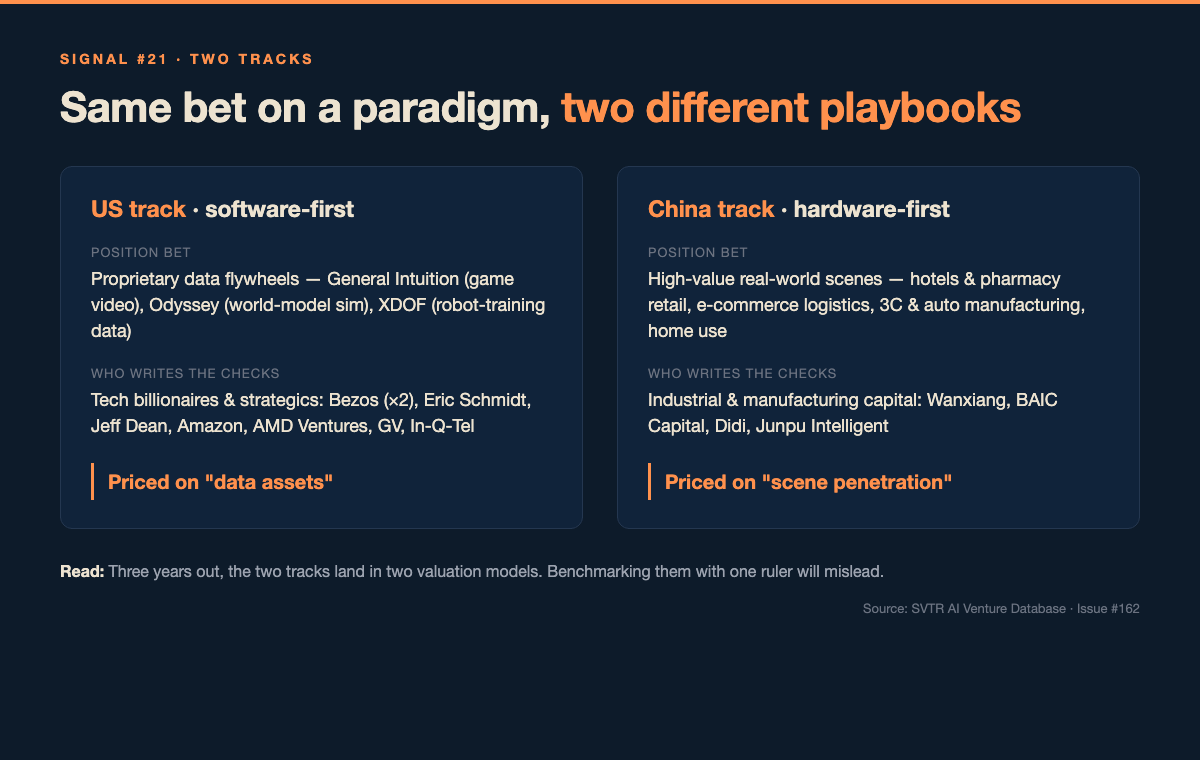
Here’s what only a cross-border view shows. The US and China are buying different positions, with different money.
The US track is software-first, betting on proprietary data flywheels. The checks come from tech billionaires and strategics — Bezos (twice this week), Eric Schmidt, Jeff Dean, Amazon, AMD Ventures, GV, In-Q-Tel. These companies will be priced as “data assets.”
The China track is hardware-first, betting on high-value real-world scenes — hotels and pharmacy retail, e-commerce logistics, 3C and auto manufacturing. The checks come from industrial and manufacturing capital — Wanxiang, BAIC Capital, Didi, Junpu. These will be priced on “scene penetration.”
Three years out, the same “physical AI” label lands in two different valuation models. Benchmark them with one ruler and you’ll be wrong.
Why now
Three forces converged. The LLM dividend window is closing, the strongest models are now free and open-weight, so capital is hunting the next “big and early” paradigm. A cohort of paradigm-grade founders was released from big labs and last-gen unicorns in 2025–2026. And two years of LLM investing proved that hesitating at a paradigm turn costs far more than overpaying one round.
What it means
For founders without a big-lab pedigree: the realistic path is to lock a high-value vertical scene and build data assets others can’t reach, not to fight for the general foundation layer. And remember that a high birth valuation is a liability, not an asset. It raises the bar for every round that follows.
For investors: the funds that judged by model benchmark scores now need a new ruler. Will this paradigm be falsified in three years, is this team truly at its core, and is the path to proprietary data or scenes already locked by an industrial player? In China especially, the best embodied targets may be claimed by industry capital before financial investors even see them.
For major tech companies and platforms: You are both the launchpad for these teams and potential buyers of them in the future. The outflow of top talents will continue, so you need to figure out in advance whether to build internal teams on your own or buy back these startups later.
For enterprise clients: Do not let huge financing rounds sway your purchasing decisions in the short term. Most of these startups are not yet capable of large-scale delivery, and their valuation does not equal their actual delivery capacity.
Tracking over 90 days
Median Round Interval: Tracks the time gap between the current and previous financing rounds for World Model / Physical AI track. If the median shortens to under 4 months, “round compression” is established as a structural trend; if it rebounds above 6 months, the heated financing is more likely an isolated phenomenon rather than a sustained trend.
Proportion of Unprofitable Companies with High Valuations: Calculates the share of Physical AI firms with a valuation of no less than $500 million and no scalable revenue in the current quarter. A rising proportion confirms “anchor shift”, while a falling proportion indicates the market is refocusing on operational milestones.
Sino-US Track Divergence Verification Rate: Monitors counterexamples such as “US enterprises shifting focus to scenario implementation” or “Chinese enterprises prioritizing data flywheel development”. Fewer counterexamples mean the judgment of “divergent development tracks between China and the US” is more credible.