

A clinical-stage company with a single drug candidate, no human trials until 2027, and a $3.1B valuation. That's NewLimit — and it's the clearest window into how the US and China are betting on longevity in opposite ways.
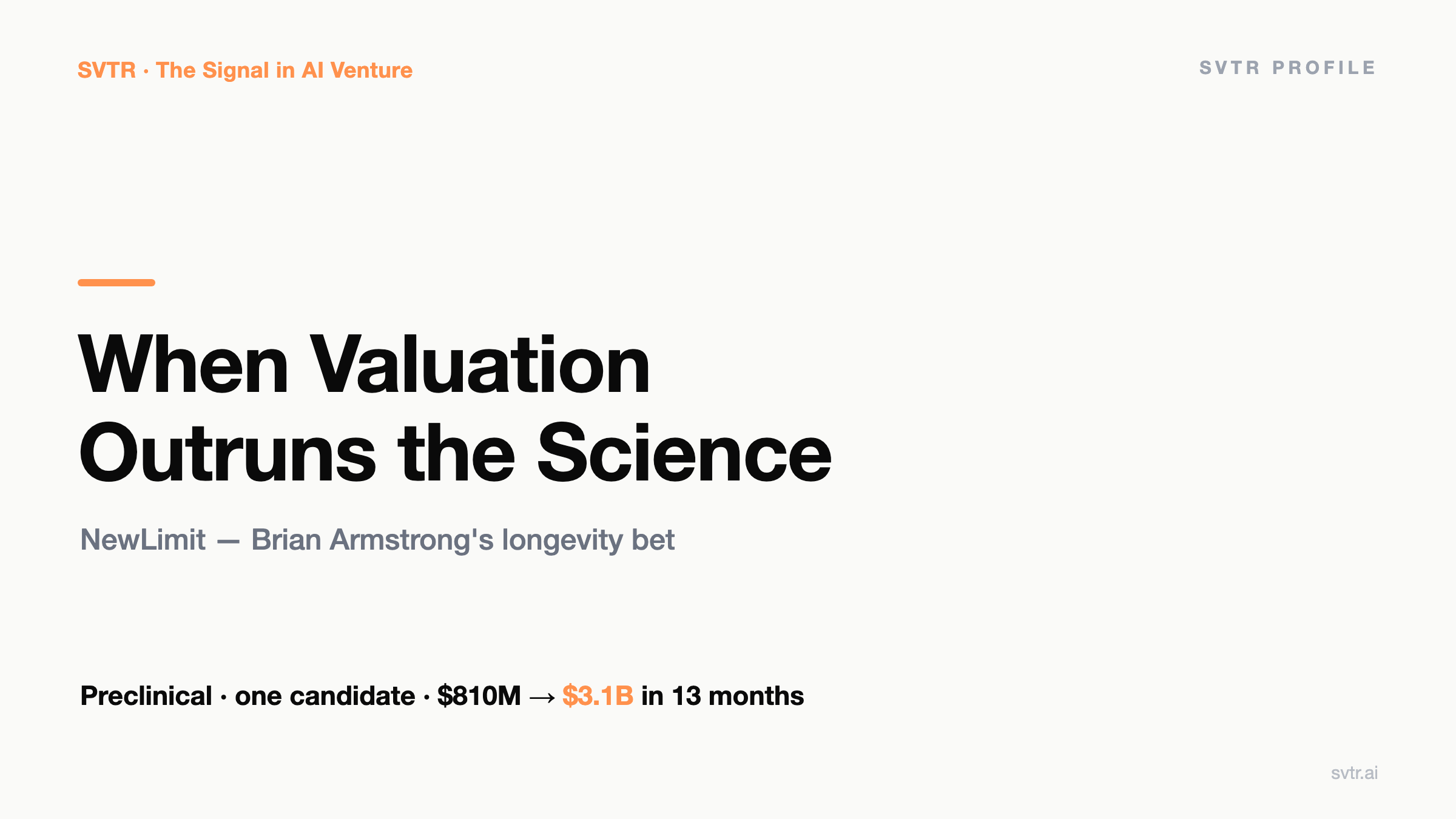
Belief, not fundamentals. NewLimit, co-founded by Coinbase's Brian Armstrong, went from an $810M valuation to $3.1B in just 13 months — entirely before any clinical data. The money holding up that price is a specific kind: crypto and AI exit wealth. Armstrong put in ~$110M himself; the same cluster includes Sam Altman's Retro Biosciences ($180M seed, raising $1B) and Bezos-backed Altos Labs ($3B at launch). They are betting on "reversing aging" as a thesis, not on a de-risked asset.
The science and the moat. NewLimit does partial epigenetic reprogramming: using transcription factors to dial back a cell's aging markers while preserving its mature identity, deliberately avoiding the cancer-prone full Yamanaka route. The real moat isn't a single drug — it's a flywheel. Its Ambrosia AI platform trained on 6.5M T-cell records and finds working factor combinations at over 2x the baseline hit rate; its in-house pxbc-seq cuts screening cost by 100x; mRNA delivery runs about $1.20 a dose. Science is moving fast — its first liver-cell candidate arrived two years ahead of plan — but there is still only one preclinical candidate, and the entire clinic lies ahead.
The mirror: China's pragmatic answer. Per SVTR's AI venture database, life sciences is the most active AI application sector, yet the US dominates 341 deals to China's 15. In the cell-reprogramming cluster, China is essentially one company: Insilico Medicine, which runs AI drug discovery, has 28 pipeline assets (nearly half already in the clinic), and signed a deal worth up to $2.75B with Eli Lilly in March 2026. Tellingly, Lilly is hedging both models — NewLimit's preclinical reprogramming in the US, Insilico's clinical pipeline in China.
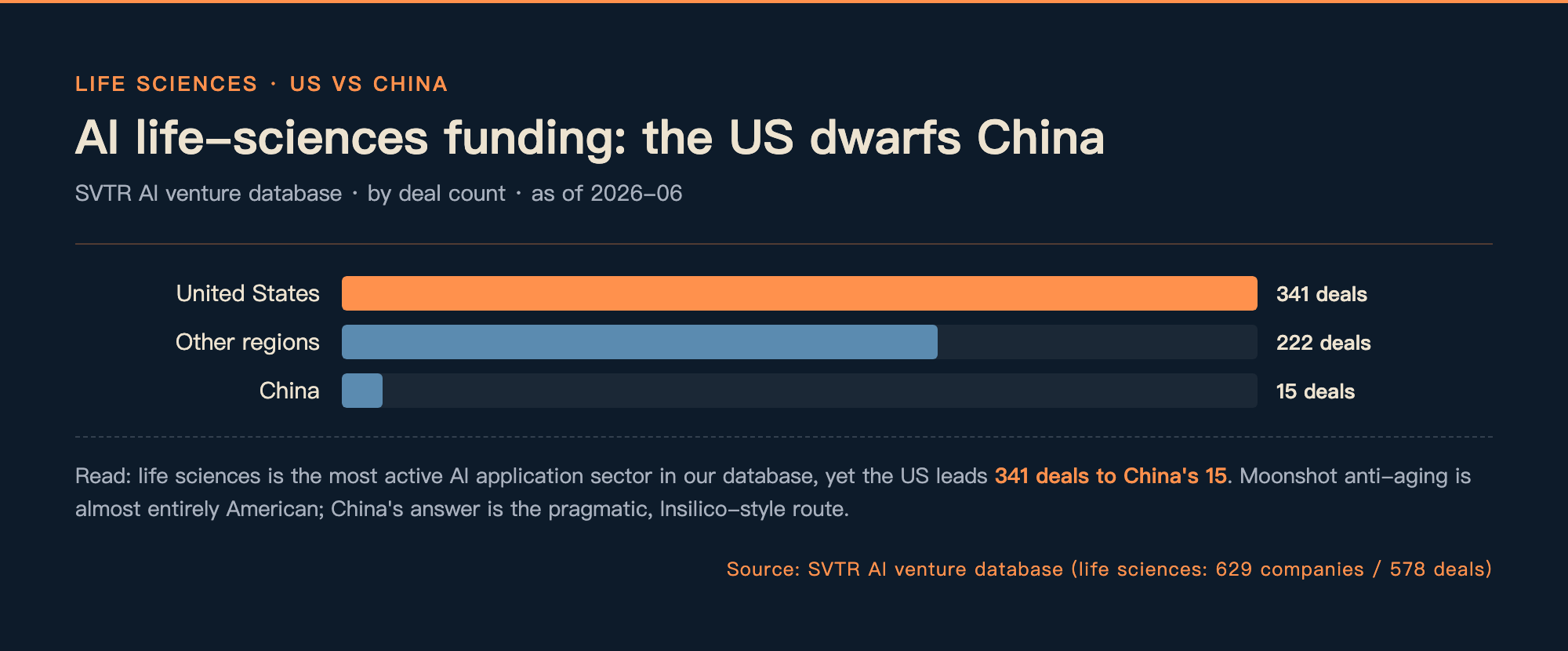
Why it matters for cross-border investors. Under the same "longevity" label, the pricing anchor differs entirely: the US bets on a scientific inflection point, with valuation running ahead of data; China ties valuation to clinical progress. A US framework will misprice the Chinese names, and vice versa. NewLimit is best read as a ten-year, high-uncertainty bet on belief — not a company you can value on fundamentals today.
Sources: SVTR AI venture database · Contrary Research · public funding announcements.