

A transcript of DeepSeek founder Liang Wenfeng’s May 2026 investor call is circulating in Chinese VC circles as the company’s unofficial strategy memo. It was auto-transcribed, unverified, and never confirmed by DeepSeek. We won’t repeat its most sensitive chip-count, procurement or financial figures. Instead, four judgments worth tracking, each flagged for how far it holds and how it would be falsified. They look scattered; they share one logic of restraint.
1. The target isn’t the chip, it’s the CUDA dependency
The most quotable line is “Nvidia is digging its own grave,” easily misread as “domestic chips will catch up soon.” Liang’s point is narrower: Nvidia’s strongest software moat is eroding as AI writes code and higher-level languages lower the cost of building and porting kernels. DeepSeek open-sourced TileKernels, built on its TileLang DSL. But TileKernels still depends on Nvidia GPUs and CUDA (13.1+, Hopper and Blackwell). What it erodes is the dependence on hand-written CUDA, not the full stack of drivers, compilers and comms libraries.
So the real claim is that CUDA’s accumulated migration cost may fall. Whether domestic silicon catches the opening still hinges on capacity, real training runs, and migration cost. SVTR’s read: the valuation anchor for domestic compute should move from “can it be adapted” to “can it train.” The only re-rating trigger is a flagship model trained end-to-end on domestic chips, with public results and a reproducible path.
2. Open source is a cost strategy, not idealism
When official serving cost is low enough, releasing weights doesn’t automatically kill the API business. Enterprises compare the total cost of self-hosting against the API price; whether weights are free is secondary. That is why DeepSeek keeps pushing compute efficiency: for compute-constrained teams, efficiency decides how large a model you can train at all. DeepSeek V4 Flash and Pro output tokens run $0.28 and $0.87 per million, under a tenth of comparable OpenAI models.
The uncomfortable read for AI-application investors: the model API layer is deliberately giving up fat margins. If model capability keeps rising and prices keep falling, what does a middle-layer company own that the base model won’t absorb? Reselling tokens or wrapping workflows won’t hold; the durable ones own a data loop, execution, or outcome delivery.
3. The gap isn’t only compute, but compute buys trial-and-error
Liang attributes most of the China-US frontier gap to compute: roughly two years behind, on a twentieth of the compute. Compute doesn’t just size the final run; it decides how many experiments a team clears before training, and how fast it recovers from dead ends. Yet he concedes high-quality data and post-training are the other binding constraint, and capex can’t close those overnight. SVTR’s read: the competitive standard is shifting from “who raised more” to “who converts compute into capability.” Buying cards is only an asset when the cards run and keep producing model progress.
4. After agents, the real step is continual learning
Liang frames progress as a ladder: language models, chain-of-thought, agents, and next, continual learning, still unsolved globally. Today’s agents lean on humans for context; most systems don’t turn a finished task into lasting capability. DeepSeek’s tell is that it builds each model first to accelerate its own R&D, so every generation raises the next one’s development speed. That is closer to what frontier labs are actually racing for than one more agent app. The restraint: continual learning isn’t a “long-term memory” button or a bigger parameter count.
5. One logic of restraint
The four answers differ; the logic is one. DeepSeek keeps base models, efficiency and AGI research inside, hands more application opportunity to partners, uses open source to lower friction and low prices to widen use, and caps commercialization so it never overrides research priority.
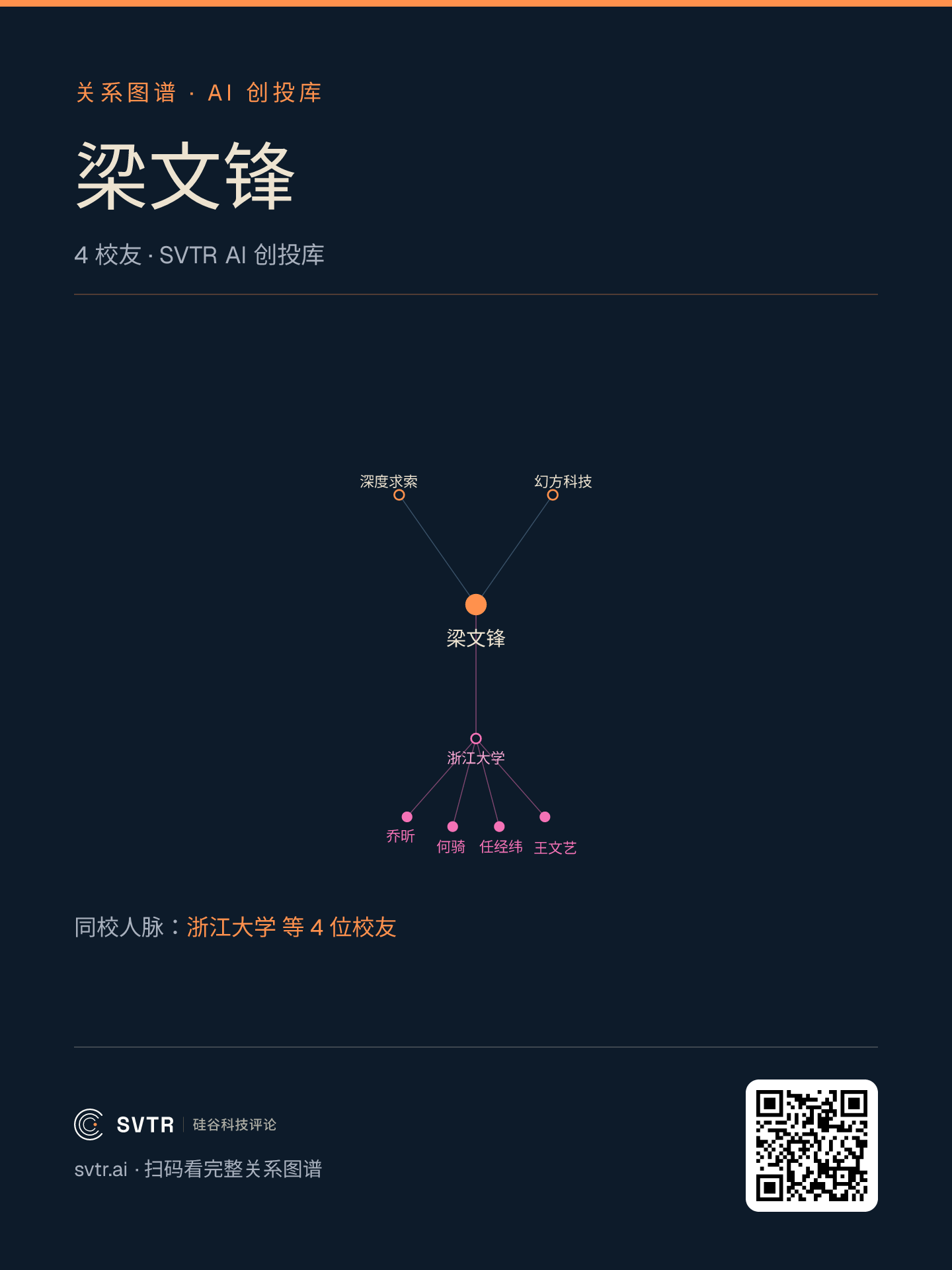
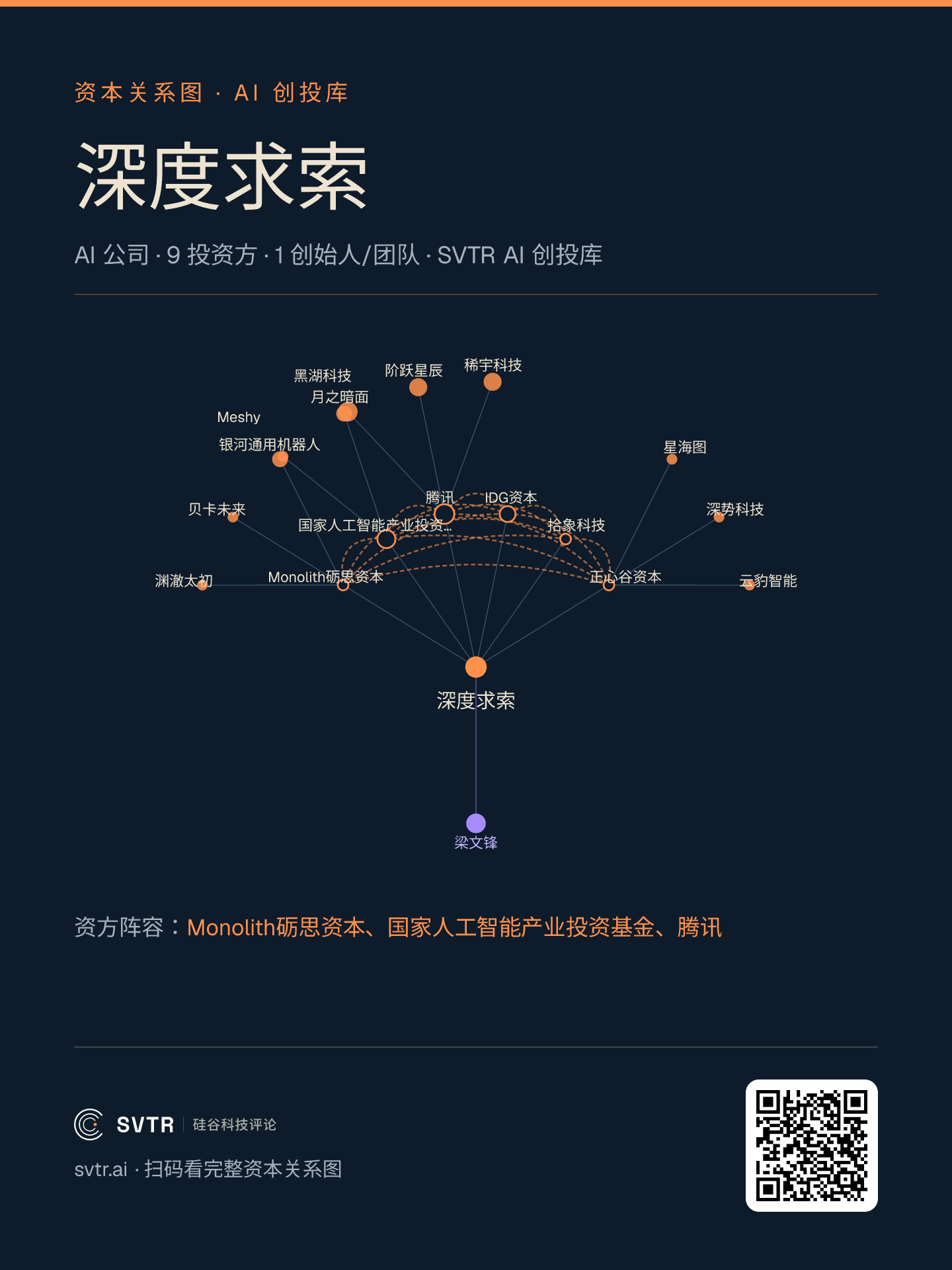
It isn’t automatically right. But the scarcity is that Liang explains every choice with one goal instead of packaging open source, low prices, domestic chips and AGI as separate slogans. It shows up in the data too: per SVTR AI Venture Database, DeepSeek’s June A-round (about $56.3B valuation) is led not by financial VCs but by the National AI Industry Investment Fund alongside Tencent, JD, NetEase and battery maker CATL, matching the transcript’s line about picking the most aligned investors. On the talent side, the DeepSeek capital graph and Liang Wenfeng relationship graph show a core team drawn almost entirely from his quant fund High-Flyer and Zhejiang University, the structural basis for “team stability is the only core interest.”
Full analysis: Liang Wenfeng’s Closed-door Talk: NVIDIA Is Digging Its Own Grave