

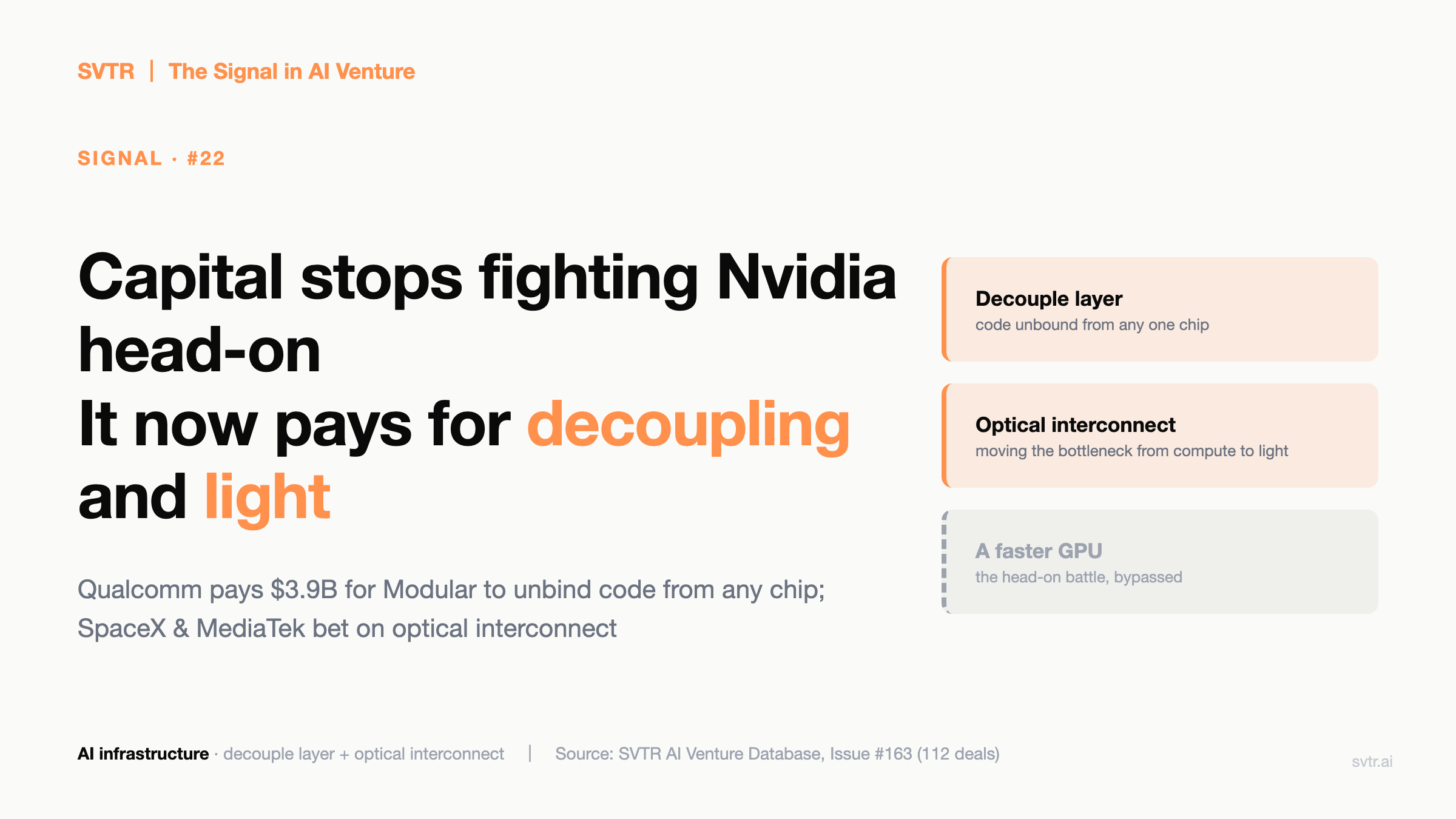
The real signal in AI infrastructure this week isn’t another Nvidia challenger. It’s that the largest infrastructure bets all walked around Nvidia’s strongest front.
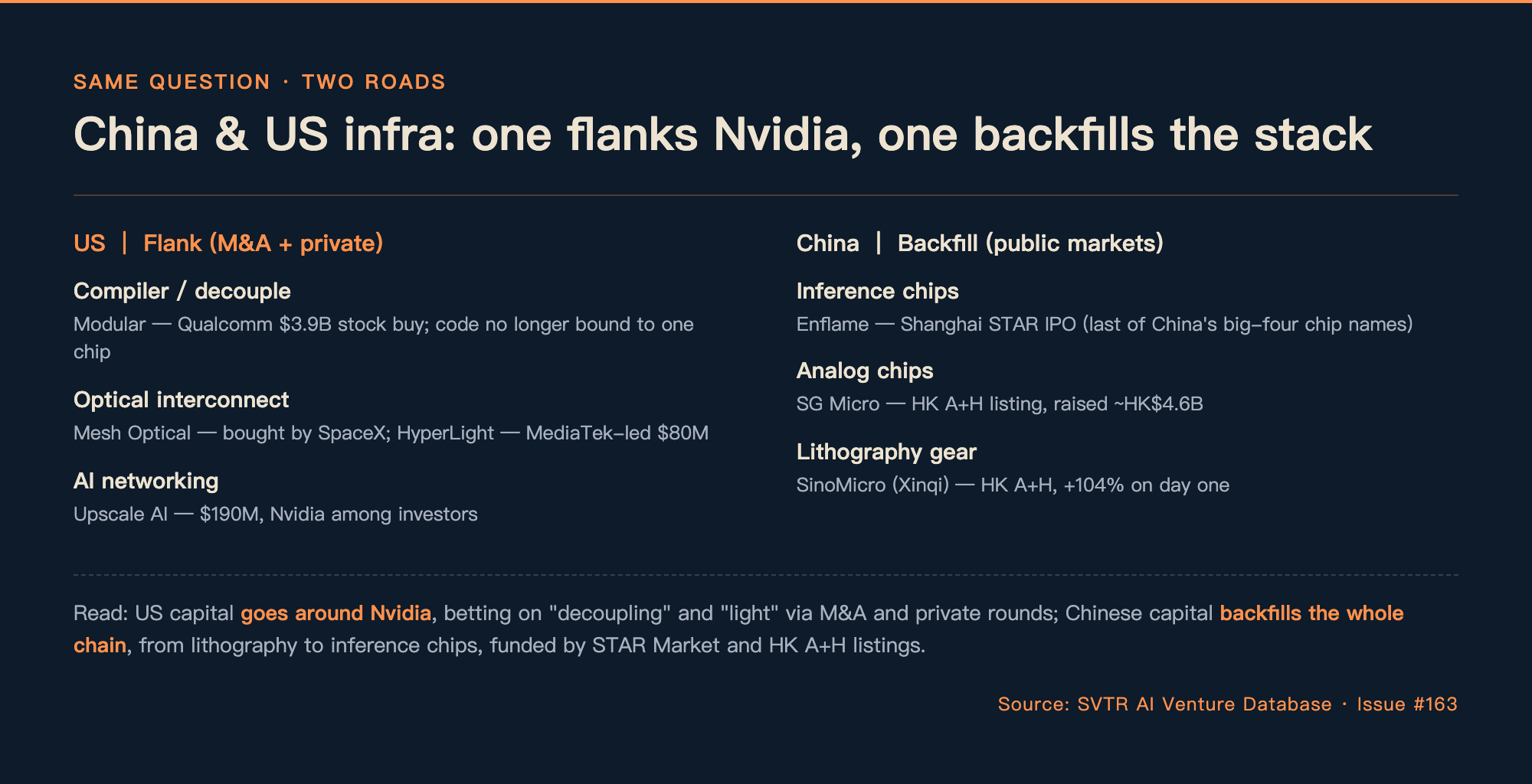
The two flanks. Qualcomm confirmed a ~$3.9B all-stock acquisition of Modular — a 2022 company that makes no chips. Its product is hardware-agnostic inference software (the Mojo language plus the MAX engine) that lets developers write AI code once and run it across CPUs, GPUs and NPUs without rewriting per chip. A chipmaker that can’t beat Nvidia on raw compute density can still buy the layer that unbinds code from Nvidia. CUDA lock-in is Nvidia’s deepest moat; whoever pries it open makes their own silicon selectable again.
The second flank is light. When single-chip compute is no longer the only scarce thing, how thousands of chips talk to each other becomes the new wall. SpaceX bought one-year-old Mesh Optical (founded by three ex-SpaceX Starlink laser-comms engineers; 1.6Tbps transceivers). MediaTek led HyperLight’s $80M Series C (thin-film lithium niobate photonics). Upscale AI raised a $190M Series A extension for open-standard AI networking — with Nvidia’s own venture arm on the list. None of these fight compute density; they sell connecting, not computing.
Why now. The load shape changed. Training is a peak load that rewards single-chip density — Nvidia’s home turf. Inference is a sustained load that rewards unit cost and the ability to wire huge fleets together efficiently. As the industry shifts from “train a bigger model” to “run models cheaply at scale,” the buyer’s pain moves from “can’t get chips” to two new things: the cost of being locked into one ecosystem, and congestion between chips. When GPU supply was tightest, no one had time for decoupling; as supply eases and inference scales, “don’t get locked in” and “connect the cards well” become fundable businesses.
The China mirror. Where US capital goes around Nvidia, Chinese capital backfills the stack — and the main stage is the secondary market. Enflame won approval for a Shanghai STAR Market IPO; SG Micro (analog) and SinoMicro (lithography gear) completed HK A+H listings on the same day, the latter up 104% on debut. One flanks via M&A and private rounds; the other backfills via public-market funding, one link at a time.
The supply gap. Of the 1,282 founders who’ve applied to SVTR, only ~7% (among those who named a sector) work on compute, chips or semis — the rest cluster in applications. Infra isn’t a founder gold rush; it’s a seller’s market where a few hard teams get chased by capital and acquirers.
Track over the next 90 days: funding and M&A in the decouple-and-runtime layer; quarterly optical-interconnect and silicon-photonics funding; and the share of domestic chip and semi-equipment names in China’s STAR and HK A+H pipeline.
Source: SVTR AI Venture Database, Issue #163 (112 deals).