

Background
On June 5, the AI-tonomy Summit 2026 was held at the headquarters of Plug and Play in Silicon Valley. More than 500 founders, investors and corporate executives attended the event. As a community partner of the summit, SVTR was present throughout the whole event. While most AI conferences over the past two years have focused on competing over AI models, this summit has seen a shift in its agenda focus.
This article will not recap the agenda. Instead, it extracts industrial trends and capital implications observed on-site, tailored for early-stage investors and founders who focus on the commercialization of agents and AI infrastructure.
There were more than 40 speeches throughout the day and 3 parallel sub-forums focusing on enterprise agent implementation, cutting-edge research, and modern AI infrastructure. No one was seriously discussing the countdown to AGI anymore; instead, everyone was talking about one thing: how to truly deploy AI into production systems. To sum up: the first phase of AI competition centers on model capabilities, while the second phase hinges on system implementation.
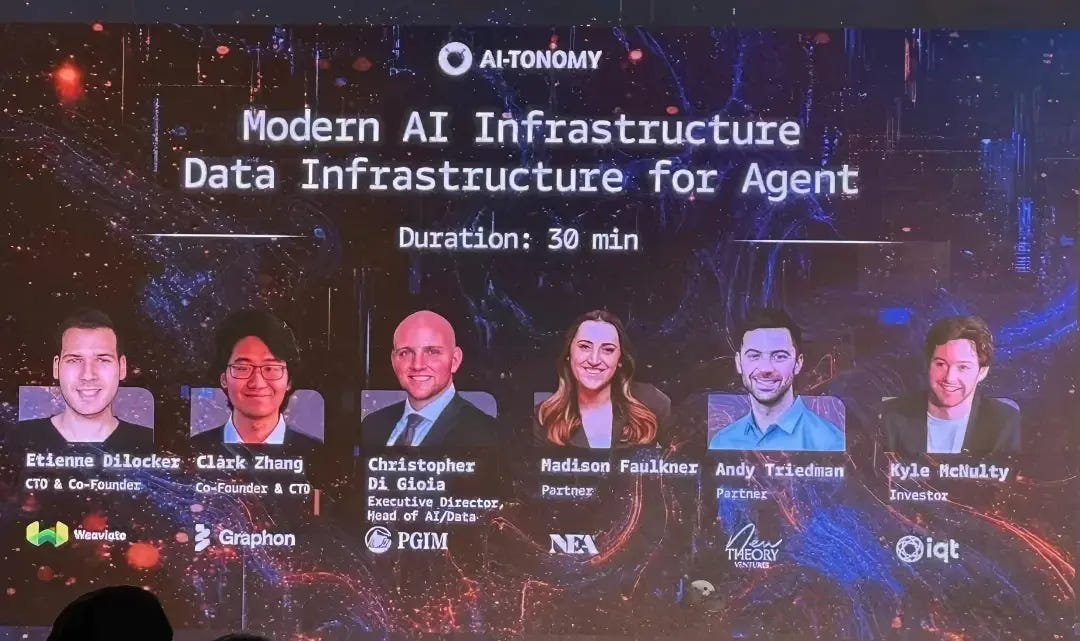
At the infrastructure roundtable, investors and entrepreneurs including Etienne Dilocker, CTO of Weaviate, Madison Faulkner from NEA, and Kyle McNulty from IQT reached a strong consensus: training remains important, yet the next major battleground lies in inference. Whether enterprises can adopt AI at scale ultimately depends on whether inference costs can be kept affordable, latency can be controlled for production use, and accuracy can meet commercial standards. The decline in token costs has fallen short of expectations, making the inference optimization stack composed of small models, fine-tuning, routing and caching far more crucial than anticipated. Many participants pointed out directly that less than 10% of enterprises have achieved large-scale AI deployment, with major bottlenecks existing in data, access permissions, compliance and governance.
When it comes to value redistribution: model companies captured nearly all the attention in the previous stage, whereas the next wave of dividends will likely go to four key sectors: inference, payment and identity, connectivity and distribution, as well as security.
The Four Layers of Infrastructure
1. Inference Layer: Turning “Adaptive Inference” into a Product
The inference layer has already produced deployable product samples. A representative case is Fastino Labs’ adaptive inference API product Pioneer, which in May 2025 closed a $17.5M seed round led by Khosla Ventures, bringing total funding to $25M. In April 2026, the company released an open-source fine-tuning and deployment package supporting Qwen, Gemma, Llama, and other major open-source models — enabling adaptive inference, automatic model iteration, and live dynamic upgrades. The model a user deploys on day one is the worst version they will ever use.
According to the SVTR database, inference is one of the few infrastructure sectors where independent companies have emerged separately in both the US and China:
US: Cerebras, Groq, Fireworks, Baseten, Fastino
China: MOFFETT AI, Enflame, SiliconFlow, QingCheng.ai, and more than ten others working on inference chips or inference stack optimization
This is a track widely favored by cross-border investors.
2. Payment & Identity Layer: Can an Agent Complete a Real Transaction?
The inference layer determines whether an agent can run. The payment and identity layer determines whether an agent can safely complete a transaction — being verified, accountable, and authorized. This is the core bottleneck in landing AI applications: many agents can already compare prices and generate order drafts, yet get stuck at the final payment step.
Two implementation directions have already produced working samples:
Application-layer sample — Snaplii:
350,000+ North American users
500+ partner brands
Annual transaction volume exceeding $100M
1,700+ agents connected
Its A2M Skill is natively MCP-compatible and can be directly invoked by large-model clients such as Claude
It has implemented three principles of agent payment: one-time credentials, tokenization (the agent only sees the token, not the card number), and commercial-grade spend limits and rules that can be revoked at any time
Protocol-layer sample — Verisense:
Focuses on discovery and interoperability between agents
Each agent has a verifiable identity
Behaviors between agents are verifiably recorded into a settlement system
Its development aligns with the latest industry trends. Google's AP2 protocol was released in September 2025 and donated to the FIDO Alliance in April 2026, with the newly added capability of unattended autonomous payment. Ping Identity's Identity for AI became officially available worldwide at the end of March 2026. Protocol-level projects feature long development cycles and rely on cross-ecosystem collaboration. They play a vital role yet have the longest verification periods among all project types.
US-China contrast: Companies in the payment and identity layer are almost entirely concentrated in the US, Europe, and Israel. Independent Chinese startups are largely absent. SVTR judges that domestic agent payments in China will most likely be embedded directly into Alipay and WeChat Pay. The opportunity for Chinese entrepreneurs lies in providing cross-border settlement interlayer services for agents going overseas.
3. Distribution & Security: One is still in the early stage, while the other is quite certain.
1) Distribution layer — still in its early stage
The cognitive sample here is Sense Space, whose thesis is that the “connection effect” of the internet is shifting toward an “awareness effect“ in the AI era:
In the past, the internet distributed content to people
In the AI era, capabilities are distributed to agents
This will give rise to new entry points for agent discovery, orchestration, and contextual recommendation. Based on its roadshow materials, this represents a platform revenue potential of over $400 million and an intermediary GMV exceeding $80 billion. However, the prerequisite for realizing this is that the agent population truly explodes.
2) Security layer — demand is already very clear
According to the founder of Horizon3.ai, attacks targeting AI systems have already emerged. Traditional security risks are amplified in the agent era, including:
Being induced to invoke the wrong tools
Permission abuse
Information leakage during inference
We believe that in the coming years, AI-native security will evolve from an auxiliary module into a prerequisite for enterprises to implement AI solutions, and thus become a relatively definite budget priority for corporate procurement.
4. The Hidden Thread and Four Tracking Directions
Beyond the four infrastructure layers lies an industry hidden thread: as the cost of acquiring information through AI keeps falling, what is truly scarce is information credibility — credible people, credible circles, and credible project screening. This is also the core logic behind SVTR’s build-out of a cross-border AI venture capital platform.
In the next phase, SVTR will track four types of companies along these infrastructure layers:
Inference layer: We focus on unit economics, as demonstration effects are not indicative of actual performance.
Payment & identity layer: Distinguish two paths with completely different verification rhythms for applications and protocols;
Connection & distribution layer: Track the real inflection point of explosive agent growth.
Security layer: Prioritize coverage as a deterministic budget direction.
Those who can build AI with lower-cost inference, safer execution, smoother payment processing and more reliable collaboration hold greater advantages today. The edge of merely pitching AGI concepts is fading away.