

A robotics startup spun out of a Toyota lab in January came out of stealth in mid-July with a $300M seed at a $1.1B valuation. Scan the cap table and you can barely find a single fund that lives on financial returns: Toyota, NVIDIA, Boeing, Samsung, CoreWeave, and warehousing giant Prologis. A seed round, and it is strategics all the way down.
This is not a one-off. Across the 84 global AI rounds we tracked this week, the same face keeps showing up. The lead seat in AI’s private market is changing hands: the checks for the next layer of AI and robotics increasingly come from the winners of the layer above, not from independent financial VCs.
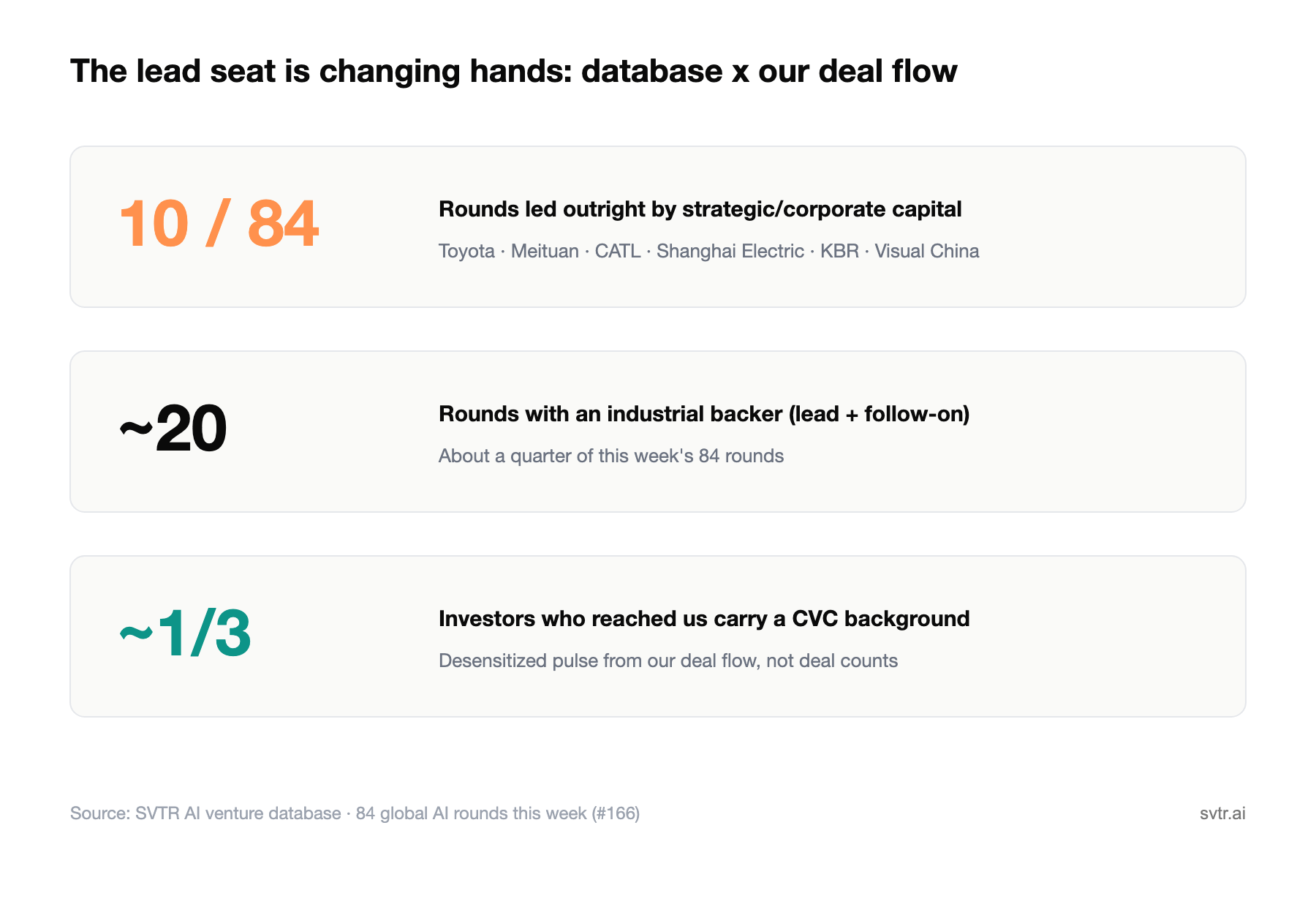
*Seed rounds get bought by strategics.* Walden has had general-purpose robots working in a Toyota plant since February. Who signs the first big check for a company like that? Not Sequoia, but the Toyota that will use it, the CoreWeave that gives it compute, the Prologis that will deploy it. For a company building physical robots, a real factory, reserved compute, and a deployment pipeline are worth more than money, and money is not the scarce thing right now.
*Even stars still raising money have started writing checks upstream.* In China the pattern is more extreme. This week AgiBot, itself still venture-funded and nowhere near an IPO, showed up as an industrial investor in two rounds: Xinqi Robotics (humanoid joint modules) and MoSense (full-body tactile sensing). Both are its own upstream components. The same week Meituan led a RMB 500M round into dexterous-hand maker Xynova. Once being a patron no longer requires profitability or a listing, a Series C company can be the next layer’s bank.
*Financial VCs are losing pricing power.* When a round is led by a strategic that wants to use, supply, or bind you, the valuation carries a “strategic premium” and the exit leans on that strategic absorbing you rather than an independent path to public markets. Independent funds get pushed to three positions: early scout, application-layer software the strategics avoid, or co-lead with ceded control.
The US–China cut is the part other platforms miss. US patrons are mostly mature giants (NVIDIA, Databricks, AMD) plus one neocloud newcomer, CoreWeave. China is supply-chain champions (CATL, Meituan, Shanghai Electric) plus venture-stage stars acting as GPs (AgiBot, SenseTime). One is led by profitable incumbents; the other looks more like picking sides.
Why now: value has concentrated upstream past a threshold, capacity and compute are scarce so non-cash resources are at their most valuable, the exit gate just cracked open (see our earlier piece on China’s capital cycle closing its first loop), and robotics has entered a supply-chain phase where components must be locked in early.
Our read: capital is starting to circulate inside the AI industry, and the independent financial VC is being squeezed out of the lead seat on the best early deals.
Read the full piece with the panorama and three metrics we are tracking