

On October 9, 2025 (PT), Silicon Valley Tech Review (SVTR) and Ivy Capital co-hosted the AI Venture Day: AI + Robotics showcase at Stanford University. Seven cutting-edge startups, each focused on high-impact real-world scenarios, took the stage. The projects ranged from data security, AI-native communication, and multi-agent collaboration platforms to hospital robotics, remote control systems, and smart prosthetics.
These are not conceptual showcases, but “in-motion products” that have already undergone validation, pilot deployment, or early commercialization—driven by simultaneous advances in both technology and business execution.
The event revealed not just the breadth of AI applications, but also three foundational trends shaping the next phase of AI adoption:
Multi-agent collaboration
Human-AI shared control systems
AI-native interaction paradigm shifts

Our Thesis:
What emerged from this showcase is not incremental tech or model improvements—but a structural rethinking of the application layer. Multi-agent systems, human-like collaboration (such as remote operation and robotic task execution), and AI-native interaction logic are becoming defining certainties.
Three notable paths to commercialization:
Agent coordination + autonomous operations: “Human-Machine-Task” triadic architectures are now deployable across security, robotics, and auditing scenarios.
Rewriting high-frequency entry points: AI-native products are re-architecting foundational functions in messaging and compliance, breaking away from traditional plugin models.
High reusability + value density scenarios prioritized: Hospital logistics and smart prosthetics offer clear economic upside and repeatable models, making them ideal for early AI scale-up.
Showcase Highlights
01|Netra Security – From Tooling to Operating System: Redefining Data Security Automation
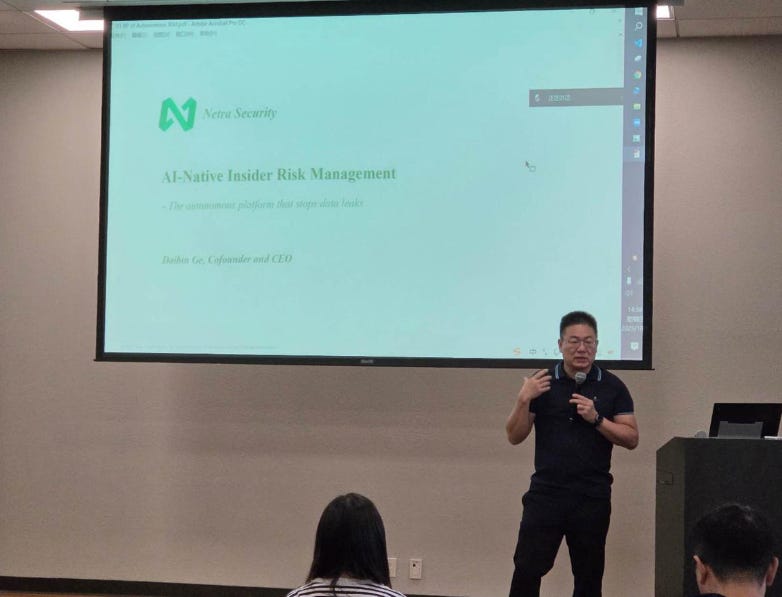
Netra tackles the inefficiencies of traditional DLP (Data Loss Prevention) solutions—often complex, ineffective, and underused—by building a multi-agent, end-to-end security operations platform. Supervised agents handle modular tasks, using a Zero Trust framework to autonomously acquire context and execute full-cycle automation—from detection to response and remediation.
Ultra-low deployment barrier: 5–10 min agent install; go-live within 4 hours for small teams; full enterprise rollout in 2–3 days.
Initial customers: Data-heavy, high-velocity industries like tech and finance. With data breach costs averaging $60K/event, ROI arrives in 6–12 months.
Key differentiator: Less about “stronger tools” and more about “lighter services”—built for even junior IT staff.
Team: Founded by the former head of security at Alibaba Cloud, with core team members from FireEye and AWS. Team of 12, product live for 9 months.
02|AIConform – Turning CPA Audits from Art into System
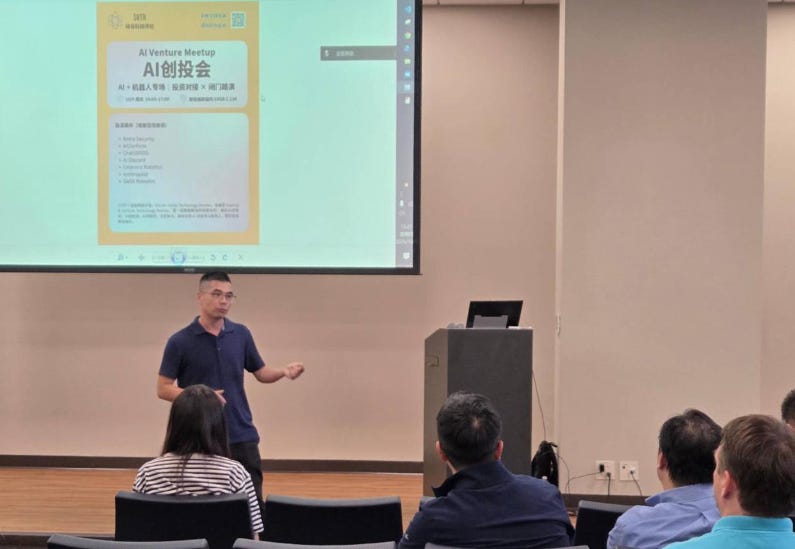
With AI regulations tightening (e.g., EU AI Act), ~20,000 of the 60,000 CPA firms in the U.S. face mounting pressure in assurance services. AIConform offers an AI-powered, workflow-configurable compliance platform that automates evidence collection, document generation, and provides style-learning-assisted review—supporting audit sampling, traceability, and anomaly detection.
Not just a toolbox, but a scalable compliance productivity platform.
Exploring M&A of small CPA firms to create tool + service integration and consolidate a highly fragmented market.
Team: Founders with academic + consulting backgrounds in AI privacy, bias, and compliance; advisors include experienced CPAs across SOC2, ISO27001, and ISO42001.
03|Chat10000 – Building an AI-Native Messaging Protocol from Scratch
Unlike AI-enhanced IM tools, Chat10000 reimagines messaging from the ground up with AI-first design. Interaction between users and AI is seamless: auto-summarizing conversations, generating to-dos, predictive replies, and memory updates—all embedded within the message stream, not tacked on as plugins.
Multi-tiered memory system (private/public), integrating emails, X (Twitter), WeChat, etc.
Goal: 10,000 paying users within 12 months.
Positioning: Not “passive transmission” like legacy IMs, but “conversation = structure; communication = collaboration.”
Team: Compact team of 4–5; serial founder with >10 projects; tech lead from IBM/Amazon with AI system deployment experience.
04|OpenAgents – Making AI Agents Collaborate Like Gamers on Discord
Built by Acenta, OpenAgents turns agents from isolated units into community-based collaborators. Developers can spin up Agent Communities with one click. Agents can discover, join, and communicate freely, powered by a real-time collaboration engine that keeps latency in the millisecond range.
Example scenarios: HR interview agent alliance (multi-round screening from a single submission), live market intelligence aggregation, and team project workflows.
Partnering with Columbia, University of Tokyo, and others to co-develop benchmarks and plugin ecosystems for multi-agent coordination.
Founder: Raphael, former Amazon AI scientist, led the first Dialog2API Admin Agent and its integration into Titan/Nova models. Published in Networks; helped deploy multi-agent systems at large tech firms.
05|Emancro – Hospital Logistics Robot Deployed at U.S. Medical Groups
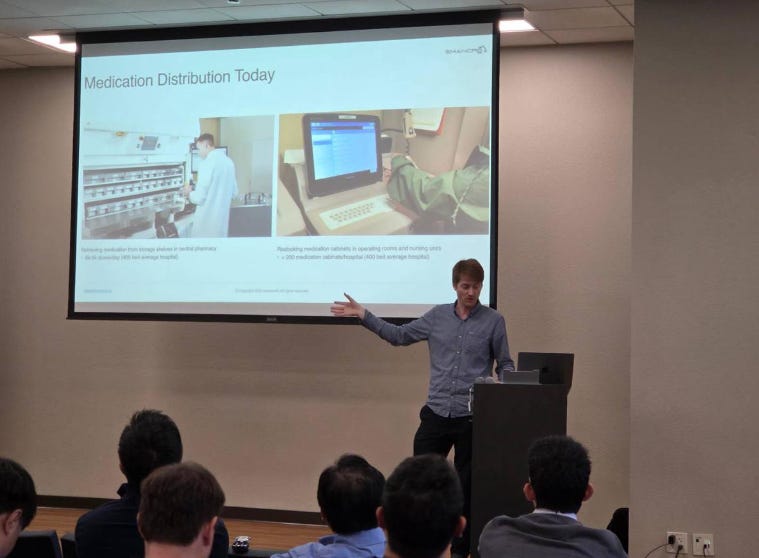
Emancro’s dual-arm hospital logistics robot is designed for high-ROI scenarios like delivering medications and lab samples. With a suction + gripper system and a VLA (Vision-Language-Action) framework, it achieves 97% task success and 150 packages/hour efficiency—even in complex environments with minimal recalibration.
Completed a 3-week pilot at Mayo Clinic; aiming for full deployment in 2026.
Priced at $80K–$120K per year per unit; ROI via reduced waste, risk mitigation, and compliance automation.
Team: Berkeley-trained founders with deep robotics/VLA expertise; strong execution in dual-arm planning and regulatory integration; exploring Chinese industrial partnerships.
06|Anthropilot – Remote Takeover Platform for Robotic Edge Cases
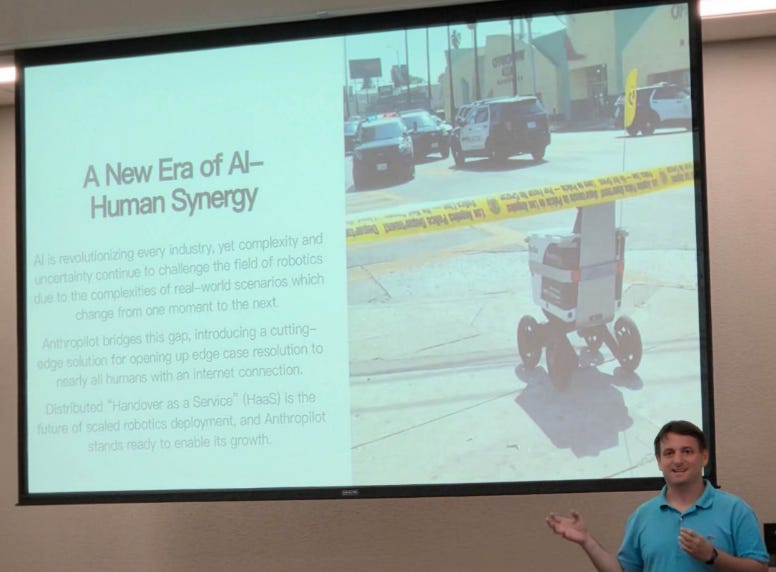
To address robots’ frequent failures in real-world long-tail tasks, Anthropilot offers a three-tier remote takeover framework:
T1: Template-driven micro-control for mainstream users
T2: Moderate control for task-specific hardware
T3: Expert-level remote ops (e.g., healthcare, hazardous zones)
The platform abstracts hardware differences across robot vendors, allowing global “gig workers” to control robots without deep technical familiarity. It’s also exploring insurance partnerships for human-AI shared safety assurance.
Team: Deep roots in middleware, real-time distributed systems, and AI decision-making; alumni networks from Cornell, CMU; advisors from top robotics firms.
Operates a dual-node (US + China) structure for data localization and ecosystem alignment.
07|Smart Prosthetic Knee – AI-Driven Intent Recognition at Breakthrough Cost
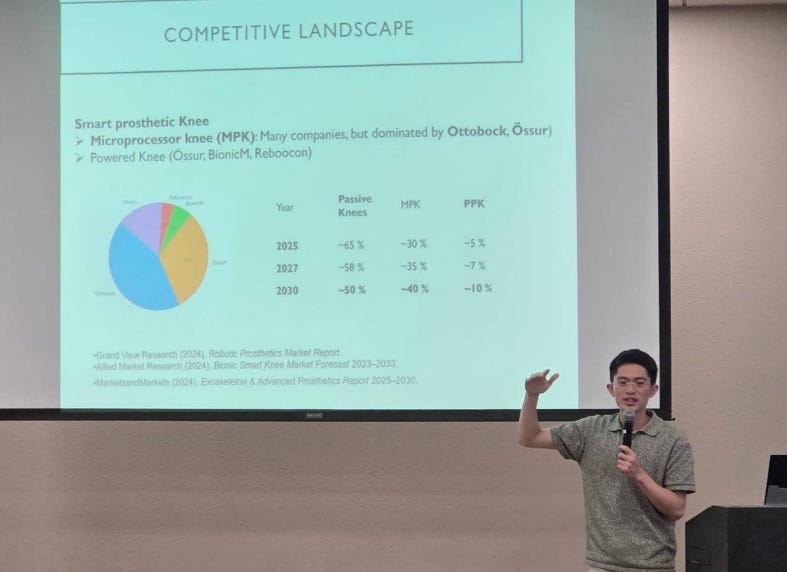
Traditional powered prosthetics often lag in response or fail to adapt to sudden movement, making hydraulic models more popular. This smart knee uses IMU-based motion prediction to adapt in milliseconds—handling variable treadmills, emergency stops, and slope walking with ease.
Fully self-developed hardware; cost kept under ¥50,000 (~$6,800), vs. $20K–$30K for top models.
Go-to-market via China first, with “SaaS + hardware” feedback loop and global compliance in parallel.
Team: Founder is a PhD from a Dutch university and Stanford visiting scholar, with long-standing work in biomechanics/exoskeletons. Backed by two senior professors. Chinese partners in rehab and fitting networks secured. Prototype completed; 4–5 person team expansion in progress.
Closing Thoughts
A Structural Rewrite Is Underway
These teams aren’t just refining tech—they’re restructuring the application layer around coordination, reusability, and composability.Three Foundational Pillars Are Emerging
Multi-agent systems: A new default for tackling complex tasks
Human-in-the-loop control: Especially in weakly supervised or high-risk environments
AI-native interfaces: Moving beyond plugins to protocol-level redesign
Smart Market Entry Strategies
Many teams are entering sectors with high reuse potential and clear value—hospital logistics, compliance, prosthetics—ensuring scalable growth paths.Faster Lab-to-Market Conversions
Multiple teams are already in pilots, revenue stages, or pricing iterations. The productization cycle is clearly accelerating.
Contact & Access
To request pitch decks, pilot data, user interviews, or live demos, contact Kerry from SVTR (kerry@svtrai.com) to apply for Dataroom access and schedule follow-up.