

This week, AI capital didn’t just grow. The primary market and the public market started moving in opposite directions.
Levering up on compute
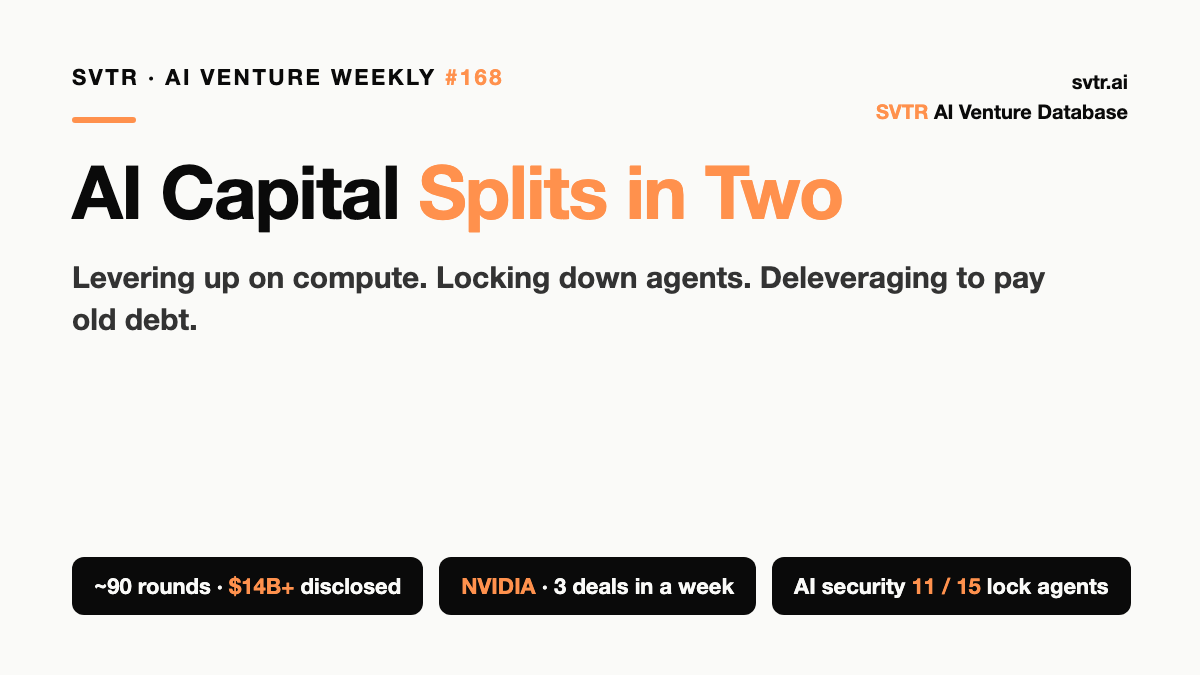
NVIDIA moved three times in one week: a $5B strategic investment in Safe Superintelligence (SSI), $1B for a 4.5% stake in Korea’s Naver to build a national AI factory, and a batch of seed rounds. Nearly 90 AI rounds were confirmed and over $14B disclosed this week (SVTR AI Venture Database #168, https://svtr.ai/funding?utm_source=substack&utm_medium=email&utm_campaign=weekly-168&utm_content=article-card). NVIDIA is turning from the picks-and-shovels vendor into the single most active investor in the primary market.
Locking down AI agents
AI security was the densest theme, and its target moved. Of 15 AI-security rounds this week, 11 went to locking down non-human identity: AI agents, service accounts, machine identities. The consolidation was just as fast: Cyera agreed to acquire Oasis Security for ~$1B ($700M cash plus stock), and Okta bought Permiso for ~$200M. Security leaders are buying, rather than building, the infrastructure to govern proliferating AI agents.
Money sank into the hardest layers
Commonwealth Fusion Systems added another $1B (to $4B total) to power AI data centers, the largest single round in fusion history. Multiverse Computing raised $570M for quantum model compression, Antora Energy $550M for industrial heat storage, K2 Space $500M for satellite platforms. Capital is settling into energy, compute, and frontier models, the three hardest layers of the stack.
Deleveraging to pay debt
On the way out, the story reversed. The “Situational Awareness” AI hedge fund blew up and deleveraged in public markets; MiniMax halved on its listing debut. Yet Chinese AI assets kept queuing to go public together: Moonshot AI (Kimi, ~$35B post-money) and GPU maker MetaX are both pushing toward Hong Kong listings. The valuations built in private now have to clear public markets, and the public market is cooling first.
Our read
The primary and secondary markets are diverging. The primary market keeps levering up with NVIDIA’s strategic capital, fusion’s mega-rounds, and dense security bets, wagering on the infrastructure that scaled AI agents will require. The secondary market is paying down two years of valuation excess, and the assets that listed first are hit first. As the tide goes out in public markets, capital concentrates into the top names and the hardest infrastructure. In a deleveraging cycle, leaders become the last safe harbor.
Full data and capital map.